An Amaryllis Potted Now Should Flower in 6 to 8 Weeks With Its Top Third Left Above the Soil, University of Wisconsin Extension Says
Eight weeks from the second week of November lands in the first days of January, and six weeks lands in the middle of December. That is the window University of Wisconsin-Madison Division of Extension gives for a potted amaryllis, which it says generally takes six to eight weeks to bloom. A bulb potted this month, with its top third left above the soil, is on track for flowers around the holidays.
The Wisconsin Horticulture publication, written by Susan Mahr, Ann Joy and Brian Hudelson and revised in June 2026, adds that amaryllis does not need a cold period the way tulips and hyacinths do. Other extension services agree on the basics but differ on how long the wait runs, so the date is a range rather than a promise.
Six Weeks to Mid-December, Eight to the New Year
Counting forward from Nov. 7, six weeks is Dec. 19 and eight weeks is Jan. 2. Wisconsin’s “six to eight weeks” sits inside the wider range other extension services publish. Penn State Extension, in a guide by Master Gardener Denise D’Aurora updated Sept. 16, 2026, says an amaryllis typically takes 6 to 12 weeks to bloom, depending on the variety. That stretches the far end to the end of January.
The Clemson Home and Garden Information Center says amaryllis can be forced indoors in four to six weeks without cooling, and the North Carolina Extension Gardener Plant Toolbox gives about five weeks after potting. Those shorter figures suggest a bulb potted in early November could open before Christmas, while a slow variety could miss it. Minnesota Extension describes a different route for gardeners who want to control the date: a bulb kept dry and dark at about 50 to 60 degrees F for 8 to 12 weeks flowers roughly 4 to 6 weeks after it is brought back into a sunny window and watered. That path starts from a bulb already resting, not from one bought fresh in November.
The same schedule is laid out beside paperwhites in a comparison of holiday bulb timing for readers who plan to force both.
A Narrow Pot, Soilless Mix and the Top Third in the Open
Wisconsin Extension says to use a container with a drainage hole and a saucer, about one to two inches wider than the bulb, filled with soilless potting mix. The bulb sits on a few inches of mix, more mix goes around it, and the neck stays exposed. In the same publication, the guidance reads that amaryllis bulbs can be planted with the top third of the bulb above the level of the potting mix.
The University of Minnesota Extension page, by educator Julie Weisenhorn and Mary Meyer and reviewed in 2026, says amaryllis grow best in narrow containers. It puts the pot about 1 inch wider than the widest part of the bulb and about twice the bulb’s height, filled halfway with sterile potting mix before the bulb goes in. Soil is then added until one-third to one-half of the bulb is still visible, and the mix is firmed around it.
Penn State lands in the same place: a pot one inch wider than the widest part of the bulb and twice as tall, with one-third to one-half of the bulb left visible. It adds that a slightly pot-bound bulb will bloom better, and that leaving the top of the bulb uncovered helps prevent fungal disease.
Water Sparingly Until a Sprout Shows
Wisconsin Extension says to water well right after planting, then keep watering sparingly until a sprout appears. Once growth starts, the soil is kept moist with more frequent watering.
Minnesota gives a simple test for later: water when the top 2 inches of soil feel dry, let the pot drain fully, and never leave it standing in water, since wet soil can promote bulb and root rot and attract pests. Fungus gnats, the university notes, are linked to soggy soil. Once new growth appears, it recommends half-strength fertilizer with each watering, using a high-phosphorus houseplant formula to encourage flowers.
A Sunny Window, Then Out of Direct Sun Once Buds Open
Wisconsin Extension calls for a cool, sunny spot. North Carolina Extension describes a well-lit, warm location of 70 to 75 degrees F for growing bulbs, and notes that plants are injured below 35 degrees F, so cold drafts are a risk. The same page lists amaryllis as medium-severity toxic and especially harmful to pets, so the pot belongs out of their reach.
Penn State and Minnesota both say to move the pot out of direct sunlight once the flower buds begin to open. Penn State adds that keeping it away from heat sources prolongs flowering. North Carolina puts the flowers at three to four weeks.
After the last bloom fades, Minnesota says to cut off the spent flowers to prevent seed formation but to leave the stalk until it turns yellow, since a green stem keeps making energy for the bulb. Wisconsin’s schedule for the next round is to stop watering in early September, let the soil dry out and the foliage die back, then resume watering in November or December. Minnesota adds that plants bloom best when slightly pot-bound and need repotting only every three or four years, after dormancy.
Get stories like this by email. Sign up for The Parent Diaries Letter.
This article was produced with AI assistance and edited for accuracy against the sources linked above.
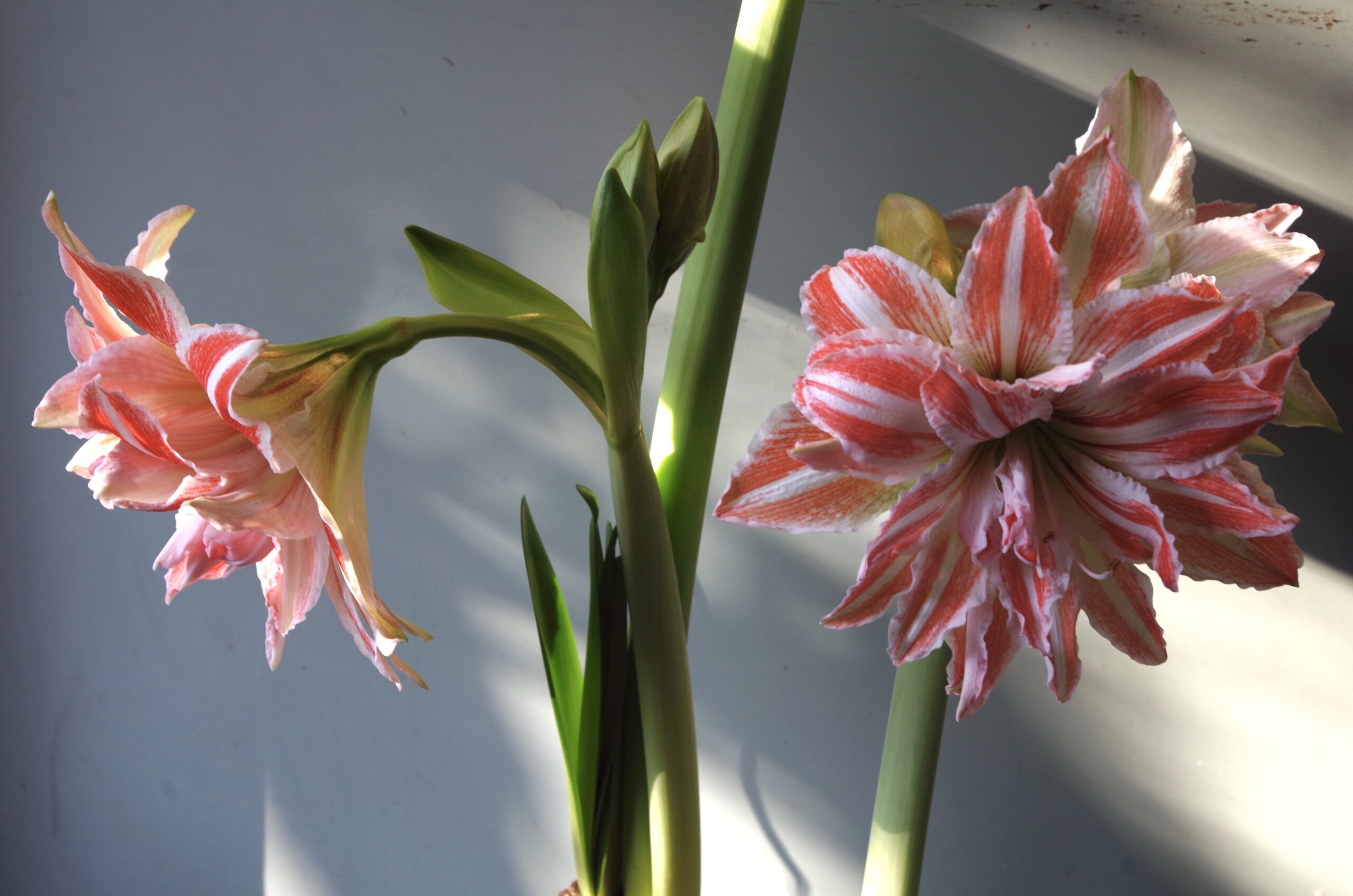
Image: “Amaryllis-DancingQueen” by ProfDEH is licensed under CC BY-SA 4.0. To view a copy of this license, visit https://creativecommons.org/licenses/by-sa/4.0/.