Cat Owner Says Her Eight-Month-Old Rescue Cat Destroyed Years of Houseplants, Then His Owners Tried One Last Trick That Made Things Even More Interesting
A couple had spent years filling their home with houseplants, carefully growing several of them long before their new cat arrived. Then they adopted an eight-month-old male cat who seemed determined to inspect every leaf, stem, and flower within reach. At first, they thought his curiosity would eventually fade.
Instead, the young cat became increasingly interested in the plants. He would sniff them, paw at them, and eventually chew them apart whenever nobody was watching. The couple soon realized they had not adopted a cat who merely liked plants, but one who seemed to consider them his personal buffet.
The Cactus Was Not Safe
The owners tried to protect their remaining favorites by moving them higher. Unfortunately, their cat seemed capable of jumping onto almost every possible surface in the flat. Even the cactus, which looked like the one plant that should have been completely off-limits, did not discourage him.
He would still approach the cactus and attempt to bite it. The owners watched in disbelief as their supposedly intimidating plant failed to intimidate the smallest member of the household. It became clear that ordinary gardening logic was not going to work against this particular cat.
Flowers Had to Hide in the Bathroom
The couple eventually stopped leaving flowers in the main living spaces. Fresh bouquets were moved into the bathroom because the cat would immediately make a beeline for them whenever they were placed elsewhere. The moment he noticed a new flower arrangement, the destruction would begin.
He would rip pieces apart and chew them as if he had been waiting all day for the opportunity. The bathroom gradually became the only place where flowers had any chance of surviving. What was supposed to be a decorated home had started looking like a house where the plants were under witness protection.
He Waited Until Nobody Was Home
The owners noticed something particularly frustrating about the cat’s behavior. When people were around, they could sometimes distract him or move him away from the plants. But whenever he was left alone, he seemed to know exactly where to go.
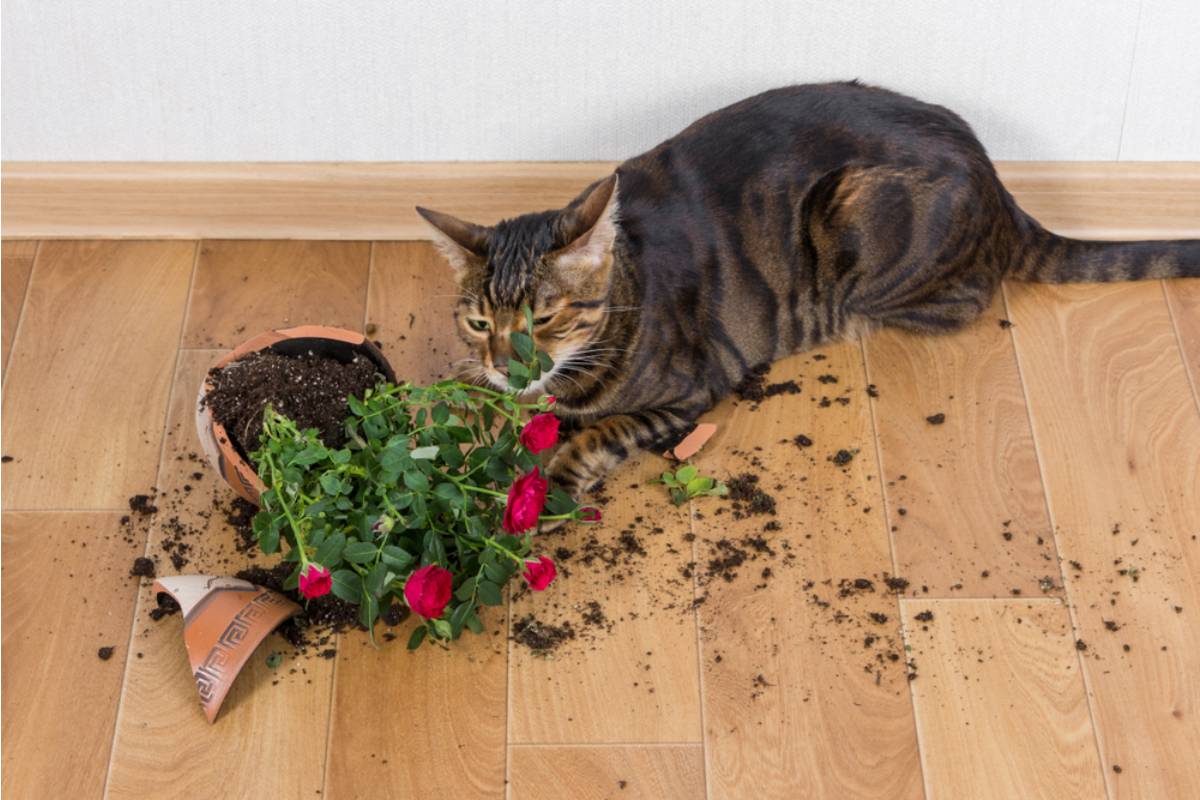
The cat would leap directly into a flower pot, chew the plant, or simply flatten himself on top of it. Coming home after being away became a guessing game. The couple never knew whether they would find a living plant or a pile of leaves scattered across the apartment.
Nothing Seemed to Work
They tried spraying the plants with mixtures containing lemon and vinegar. They also bought an enormous collection of toys and gave the cat his own cat grass. Commercial cat repellents were added to the growing list of failed experiments.
None of it seemed to make much difference. The cat ignored their carefully planned defenses and returned to the plants with remarkable determination. Every failed solution only made the owners more certain that they were dealing with an unusually stubborn little gardener.
The Latest Disaster Was the Final Straw
One day, the couple returned home to discover plant pieces scattered throughout the apartment. The scene looked as though a miniature storm had passed through the living room, except the storm had teeth and whiskers. The owners had reached the point where they were genuinely wondering whether they could keep houseplants at all.
The problem was not simply the damage to the plants. Some of them had been growing for years before the cat arrived, making their destruction especially upsetting. The couple wanted a solution that allowed both the cat and the plants to remain part of the home.
A Response From a Person Suggested Aluminum Foil
A response from a person suggested putting aluminum foil over the soil. The theory was that the unusual surface might make the pots less appealing to a cat looking for somewhere to dig or settle. It sounded simple enough that the owners were willing to consider trying it.
Unfortunately, the cat had already demonstrated that ordinary obstacles did not impress him. The owner explained that he simply walked across foil placed on other surfaces or jumped over it entirely. Still, the idea of placing it directly inside the flower pots had not yet been tested.
Then Someone Suggested a Cat Buddy
Another response from a person floated an even bigger idea: perhaps the energetic cat needed another cat to keep him occupied. The suggestion was that a companion might provide him with enough entertainment to reduce his obsession with the plants. For a moment, the couple had to wonder whether the solution to their plant problem might involve adding another animal.
Then a response from a person shared a hilarious warning. Someone had apparently tried getting a second cat to distract a plant-destroying cat, only for the original troublemaker to teach the newcomer all his destructive habits. Suddenly, getting another cat sounded less like a solution and more like doubling the gardening disaster.
Citrus Became Part of the Battle
A response from a person recommended using lemon juice on the plants, suggesting that many cats dislike strong citrus scents. Another suggestion involved something considerably more intense for particularly determined chewers. The homeowner had already tried lemon and vinegar, so the idea was familiar but clearly had not produced a miracle.
The strange part was how many different strategies people had tried against plant-eating cats. Some relied on smells, some on distractions, and others on physical barriers. The couple seemed to be slowly discovering that every cat has its own rulebook.
The Plants Might Need Armor
One response from a person suggested using terrarium plants and hanging planters attached securely to the ceiling. Physical separation, they argued, might be the only reliable solution for a cat this determined. It was a frustrating conclusion for anyone who wanted plants displayed normally around the home.
The owners had already learned that simply placing a plant on a higher shelf was not enough. Their cat could jump farther than expected and seemed unusually committed to reaching anything green. The idea of putting plants behind glass or high above the cat suddenly looked much more practical.
Cat Grass Created a Curious Compromise
Another response from a person suggested giving the cat an entire supply of cat grass that he was allowed to chew freely. The idea was not necessarily to make him stop eating plants, but to provide a plant that was officially his. A large planter filled with grass could potentially become the feline equivalent of a designated snack garden.
There was one obvious problem, however. The cat might simply destroy the cat grass faster than anyone could grow it. The owners would have to protect their edible offering long enough for it to remain useful while somehow convincing him that the other plants were off the menu.
One Family Used a Slow Reintroduction
A response from a person shared a more unusual strategy. They had removed all their plants temporarily and then slowly brought them back one at a time over several weeks. By changing the novelty of the plants and controlling how they were reintroduced, they found that their cat eventually became less interested.
The method also depended on keeping the cat mentally occupied with toys and other activities. It was not an overnight solution and required patience. For the couple, though, patience might be preferable to waking up every morning and discovering another destroyed plant.
The Cat Got His Own Plant
Another household had discovered that giving their cat a plant of his own could help establish a boundary. Instead of constantly treating every plant as forbidden treasure, they provided one plant that he was allowed to investigate. The strategy gave the cat something interesting without requiring every piece of greenery to disappear.
The homeowner began considering whether the same principle could work in their home. Perhaps the secret was not convincing the cat that plants were boring, but convincing him that only one particular plant was his. It was a surprisingly simple idea for an animal that had already defeated sprays, toys, foil, and elevated shelves.
Then Came the Funniest Warning
A response from a person offered one final piece of advice that made the entire situation sound even more chaotic. They joked that the owners might want to remove the plants before the cat decided the flower pots themselves made excellent bathrooms. It was meant humorously, but the possibility was enough to make the couple imagine an even worse version of their indoor gardening nightmare.
At that point, the cat had already attacked flowers, demolished houseplants, and challenged a cactus. Nobody could confidently say what he would do next. The owners had brought home a healthy, active young cat, but they had apparently also adopted a tiny landscape designer with absolutely no respect for property boundaries.
The Cat Had Accidentally Become the Gardener
In the end, the couple’s biggest problem was not that their cat disliked houseplants. It was that he seemed to love them far too much. Every attempt to discourage him only produced another story about his determination, from leaping onto high surfaces to flattening himself inside pots.
The biggest twist was that the cat had transformed the family’s approach to indoor gardening completely. They were no longer choosing plants simply for beauty, but for whether they could survive life alongside an eight-month-old plant enthusiast. Their home might never look the same again, but at least everyone now knew who was really in charge of the indoor garden.