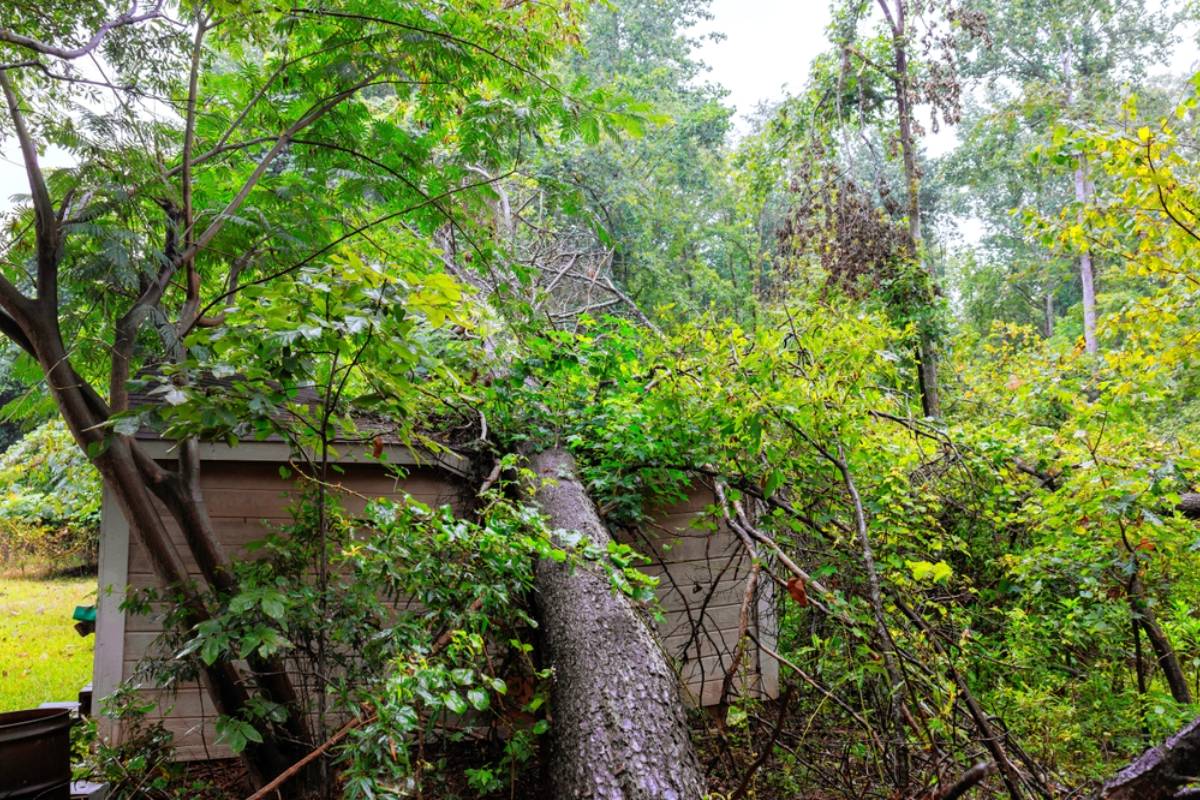
Homeowner Says Her Massive Oak Grew Across the Property Line and Toward a Neighbor’s House, Then an Unexpected Utility Visit Changed the Whole Situation
For nearly two decades, an enormous oak tree quietly dominated the backyard of an 80-year-old homeowner in Southern California. Its canopy had become so wide that several heavy branches stretched across the property line and toward a neighbor’s house, with some limbs appearing to come dangerously close to the roof. What made the situation even more complicated was the fact that the two homeowners had never actually spoken during all those years.
The tree had not suddenly become a problem overnight. Instead, it had slowly expanded season after season, sending branches farther across the boundary while utility wires became tangled among the upper limbs. The homeowner had already tried to find out what professional trimming might cost, but one estimate came back at a staggering $10,000. At her age and with very limited money available, that number felt less like a solution and more like a locked door.
The Oak Had Quietly Crossed the Property Line
The homeowner explained that the large oak stood in the backyard and had several substantial branches reaching into the neighboring property. Some were so close to the nearby house that she could not stop worrying about what might happen during a storm. From her perspective, the tree had become an expensive problem simply by continuing to grow.
The strange part was that the neighboring homeowners had never complained. Because their homes were not on the same street, the two households had apparently gone about their lives for 20 years without ever having a conversation about the oak. That silence left the homeowner wondering whether the neighbors had not noticed the branches or simply were not worried about them.
Two Households Shared a Tree Without Sharing a Conversation
It is easy to imagine how awkward that situation could become. One property had an enormous tree reaching into another property’s airspace, yet the people living closest to the branches had never knocked on the door to discuss it. Every season, the oak continued growing while the homeowners remained complete strangers.
The homeowner seemed especially troubled by the possibility that the silence might end suddenly after a branch caused trouble. She was not ignoring the tree because she did not care. She was trapped between recognizing the potential danger and knowing she simply could not afford the price quoted for major work.
Then the Utility Wires Made Everything More Complicated
The oak was not merely spreading toward the neighbor’s yard. It was also growing directly beneath utility lines, with large branches developing around the wires. That detail turned an already stressful landscaping problem into something that could potentially involve a much more specialized kind of tree work.
The homeowner had good reason to be cautious around anything involving overhead electrical lines. She was already worried about damage to the neighboring house, and now there were utility wires woven through the tree’s upper branches. Suddenly, this was no longer just a question of pruning a few limbs with a ladder and a saw.
A $10,000 Estimate Left Her Searching for Another Way
At one point, the homeowner had received an estimate of approximately $10,000 to trim the tree. For someone living on limited resources, that was not the kind of bill that could simply be absorbed with a little budgeting. The estimate effectively forced her to consider whether doing nothing might be the only realistic option.
That was what made her request for advice so understandable. She knew the oak needed attention, but she had no obvious path to paying for extensive professional work. She also worried that waiting too long could create an even bigger problem if one of those heavy branches eventually failed.
The Homeowner Was More Worried About Liability Than Appearance
This was never really about making the backyard look tidier. The homeowner openly admitted that she felt bad about the branches stretching over the property line, but her larger concern was what might happen if they damaged the neighboring property. The word that seemed to hang over the entire situation was liability.
A response from a person suggested that the homeowner start by communicating honestly with the neighbors. Rather than promising to handle a bill she could not afford, she could explain the situation and let them know that they were welcome to address the branches extending over their side, provided the tree was not harmed.
One Suggestion Put the Neighbor in the Driver’s Seat
That idea changed the situation in an interesting way. Instead of waiting for a confrontation, the homeowner could approach the neighbors and explain that she lacked the money to remove the overhanging limbs herself. She could then make it clear that she was not refusing to cooperate, only acknowledging that the financial burden was beyond her means.
For a tree that had quietly become a shared concern, that simple conversation might have been the missing piece. The neighbors had never raised the issue, but that did not necessarily mean they were unaware of it. Sometimes a property dispute remains dormant simply because nobody wants to be the first person to start the conversation.
Another Person Pointed Straight at the Utility Company
The branches around the power lines prompted another response that seemed especially important. A person suggested contacting the power company before attempting anything else because utility companies sometimes inspect or handle vegetation growing too close to electrical infrastructure.
That suggestion offered a possible escape from at least part of the $10,000 problem. If some of the dangerous work fell under utility vegetation management, the homeowner might not have to shoulder the entire cost herself. More importantly, anything involving branches wrapped around utility wires was something that deserved professional attention rather than a backyard experiment.
Then Edison Actually Showed Up
The homeowner soon revealed that the utility company had already visited. Edison had trimmed the tree, but only to a limited extent, leaving the majority of the enormous oak untouched.
That detail created another twist in the story. The utility company had apparently addressed some of the concern around the lines, but the branches reaching toward the neighboring house remained. The biggest part of the homeowner’s problem had survived the visit.
One Response Suggested the Tree Might Not Be an Emergency After All
Another person offered a much calmer interpretation of the situation. Since the neighbors had never complained and the utility company had already come out, they suggested that the homeowner might not need to panic or rush into a massive $10,000 project.
The same response also raised the possibility that the original quote was simply far higher than necessary. Getting several estimates from reputable tree professionals could reveal whether the first contractor had priced an unusually difficult job or had simply aimed extremely high. For a homeowner on a tight budget, comparing estimates could make a significant difference.
The Ten-Thousand-Dollar Price Tag Suddenly Looked Less Certain
The original estimate had seemed like the final answer, but now there was a reason to question it. Tree work can vary dramatically depending on access, equipment, the size of the limbs, and the risks involved, particularly when utility lines are nearby. A second or third professional opinion might produce a very different number.
That possibility gave the homeowner something she had been missing: options. She did not suddenly have the money to solve everything, but she might not have needed $10,000 either. Sometimes the first estimate becomes frightening simply because there is no second number beside it for comparison.
A Different State Offered Another Interesting Example
One person brought up a completely different experience from Georgia. In that situation, trees near utility infrastructure could be handled by the power company, which might remove vegetation around the lines without charging the homeowner for the tree work itself.
There was an important catch, however. The utility company might leave the wood behind after taking the tree down, meaning cleanup and hauling would become the property owner’s responsibility. Even so, the example illustrated how much responsibility can vary depending on the utility provider and local circumstances.
The Oak Itself Could Have Been Worth Something
The Georgia example also introduced an unexpected twist involving all that heavy oak wood. Rather than viewing every fallen limb as a disposal problem, the person suggested that someone might want the wood for firewood.
That may not solve the entire landscaping challenge, but it shows how a tree problem can sometimes contain a small opportunity. Large oak branches are certainly not the kind of material people always want to pay someone to haul away. Depending on local rules and the condition of the wood, finding someone willing to take it could reduce cleanup expenses.
The Neighbors Might Be Allowed to Handle the Overhang
Several responses returned to the same basic idea: branches extending across a property line may be something the neighboring homeowners can address on their side. A person suggested telling them that they were welcome to trim the overhanging portions as long as the work did not seriously damage the tree.
That possibility could remove some of the pressure from the elderly homeowner. Instead of paying for every branch across the boundary, she could communicate openly and allow the neighbors to decide how concerned they were about the limbs near their house. The key issue, of course, would be making sure any work was handled safely and appropriately.
But Then Came the Most Frightening Response
Not every response was reassuring. One person gave the homeowner a blunt warning that she could still face responsibility if a limb caused damage to the neighboring property.
That statement appears to have touched the exact fear behind the original question. The homeowner was not merely worried about an ugly tree or an awkward conversation. She was trying to understand what could happen if one of those massive limbs finally broke loose and landed somewhere it should not.
The Real Problem Was Bigger Than Pruning
By the end of the discussion, the oak had become much more than an ordinary landscaping headache. It involved property boundaries, neighboring homeowners, utility lines, a potentially enormous bill, and the growing concern of an elderly homeowner who did not have the financial means to simply hire a crew and make the problem disappear.
Yet the story also showed why the first answer is not always the final answer. A utility company had already done some work, several people suggested speaking with the neighbors, and others encouraged the homeowner to seek additional estimates. What began as a frightening $10,000 tree problem suddenly had several possible paths forward.
The Giant Oak Was Still Standing, Waiting for the Next Move
For 20 years, the tree had grown almost unnoticed while two neighboring households lived their separate lives. Now its largest branches had become impossible to ignore, stretching over the property line and toward another home while utility wires threaded through the canopy above.
The homeowner’s situation remained complicated, but the responses revealed an important lesson for anyone with a mature tree near a property boundary. A giant oak can take decades to become a problem, but solving that problem often starts with something much simpler than a chainsaw: communication, professional advice, and figuring out exactly who is responsible for which part of the tree.