November Is the Ideal Month to Plant a New Tree, Extension Experts Say, in a Hole Twice as Wide as the Root Ball but No Deeper
Josh Fuder, an agriculture and natural resources agent with UGA Cooperative Extension in Cherokee County, Georgia, says a fall-planted tree will perform better than a spring-planted tree. The reason is timing: roots get a head start before summer heat starts pulling moisture out of the plant.
Other extension services agree. The University of Arkansas Division of Agriculture’s November garden guide calls this month the most ideal time to put a new tree in the ground, and the planting method is nearly identical from state to state. Four steps cover it.
Step 1: Pick the Tree and the Spot Before Touching a Shovel
The Arkansas Extension November guide says November is “the most ideal time” to plant trees “so the plant has time to establish a healthy root system.” The same page tells gardeners to consider the tree’s mature size, the color of its fall foliage and its location in the yard.
It also advises against planting under power lines or too close to a house or other building. Space around the tree matters as much as the species.
Drainage is the other early check. Fuder suggests filling a dug hole with water and watching how fast it empties. If it drains at less than 1 inch per hour, UGA Extension says to choose a different species or raise the planting site. Planting also depends on the ground. The University of Missouri Extension’s November gardening tips describe planting trees and shrubs as ideal this month “as long as the ground is not frozen.”
Step 2: Dig Twice as Wide as the Root Ball, but No Deeper
This is the rule most extension pages repeat. UGA Extension says to dig the hole at least two times as wide as the root ball, and not deeper than the root ball. Texas A&M’s Aggie Horticulture planting guide, written by extension horticulturist Douglas F. Welsh, gives the same measurements: twice as wide as the root ball and no deeper than its height.
Michael Kuhns, an extension forestry specialist at Utah State University, explains the logic in a TreeUtah newsletter article. Roots grow mostly sideways and stay fairly shallow, so a wide, shallow hole matches how they spread. Loosened soil around the ball has more pore space, which lets new roots push out quickly. Kuhns writes that the hole can be two to five times as wide as the root ball, and wider still in very poor, compacted soil.
Depth is where mistakes happen. UGA Extension warns against putting loose soil under the roots because it compacts and leaves the tree planted too deep. Utah State says a ball resting on undisturbed soil will not sink, and sinking is what buries the root collar. The article warns that buried roots “do not get enough oxygen and will suffocate.”
On compacted or waterlogged sites, Utah State says the hole can be dug shallower, with backfill mounded up to the root collar. The root collar should sit level with the surrounding soil.
Step 3: Prepare the Roots and Backfill With the Soil Already There
Before the tree goes in, UGA Extension says to remove all wrapping and check the root ball for circling roots, then cut those roots in a few places so they grow outward. Tags and labels should come off too, because they can girdle a branch as it thickens. Utah State adds that extra room makes it easier to take out wire baskets and burlap.
In heavy clay, the extension agent recommends scoring the sides of the hole so roots can break through. Utah State makes a similar point, advising that glazed sides be roughened with the tip of a spade.
Backfill should be the native soil that came out of the hole. UGA Extension says too much organic matter can cause drainage problems, and Texas A&M advises against adding amendments such as compost, peat moss or shredded pine bark to the backfill.
Fertilizer is not part of the planting day. UGA Extension says not to fertilize at planting. If the tree needs a boost, a slow-release product can go on the following spring.
Staking is optional. Texas A&M says it is generally not recommended, but if the trunk is not sturdy enough to stand alone, two stakes, one on each side, can stay up for the first year only. Missouri Extension adds that guy wires on newly planted trees should still be covered with rubber or cloth so they do not rub the trunk in wind, and they can usually come off about 12 months after planting.
Step 4: Water, Mulch 2 to 3 Inches and Keep the Trunk Clear
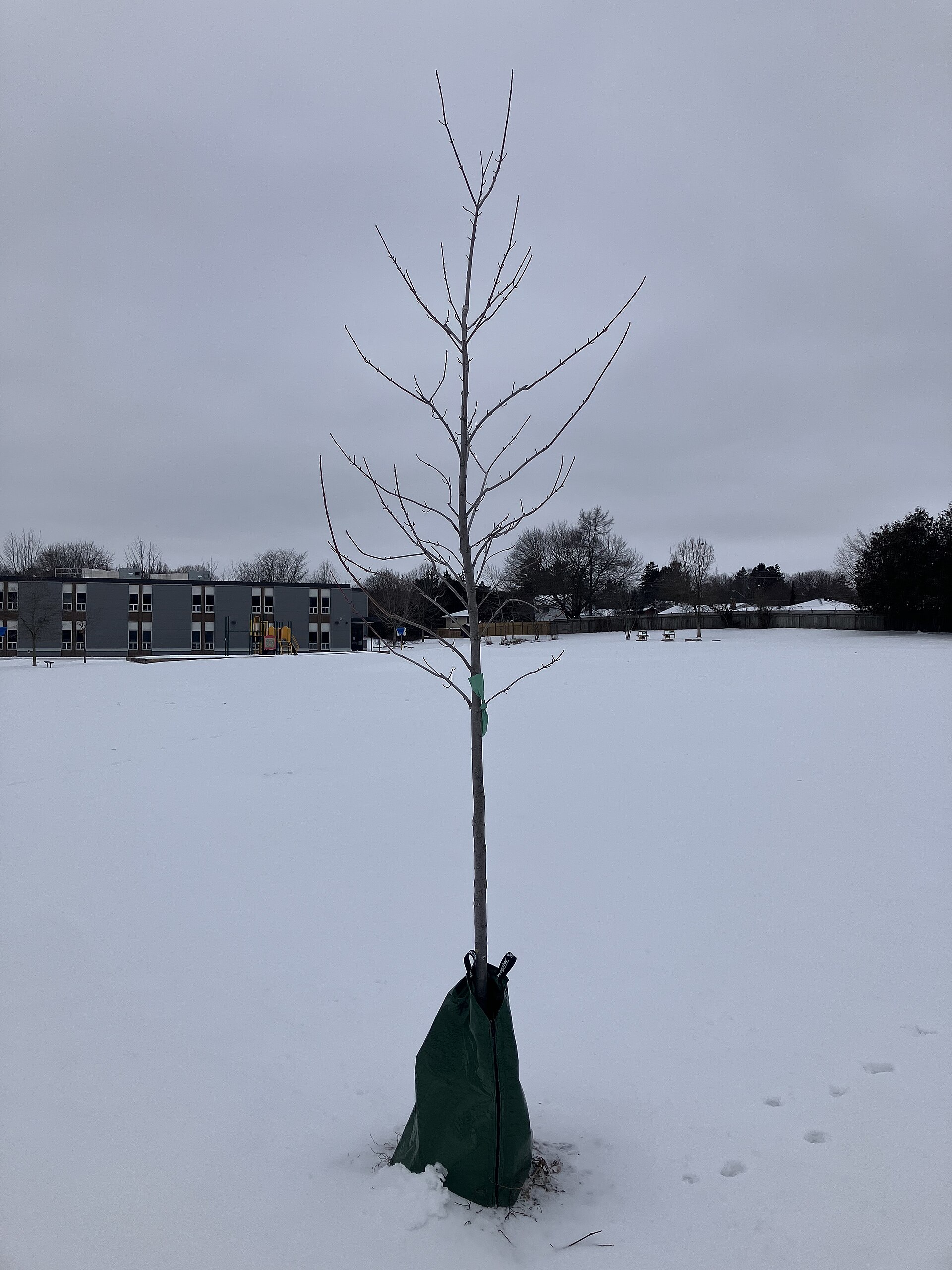
UGA Extension says to water thoroughly right after planting and then as needed through the winter. Virginia Cooperative Extension has likewise urged deep weekly watering for stressed landscape trees until the first frost. Texas A&M gives a gradual schedule for the basin built around the hole: daily in week one, every other day in week two, every third day in week three, and weekly from week four if the soil under the mulch is warm and dry. Its author suggests checking that soil with an index finger before adding water.
Mulch comes next. UGA Extension calls for 2 to 3 inches, spread over at least the area under the tree’s drip line, and kept away from the trunk. Texas A&M builds a 4-inch tall berm around the planting hole and fills it with mulch, so the basin holds water above the root zone.
Missouri Extension also recommends tree wrap on trunks in fall to prevent frost cracking or sunscald, especially on thin-barked trees such as maples and many fruit trees.
Arkansas Extension’s same November guide covers transplanting too. It advises moving trees and shrubs on a day that is not too cold, digging the new hole before lifting the plant, and not leaving the roots exposed to the air for long. That quick handling is as useful for a nursery tree as for one being relocated across the yard.
The result, according to the extension specialists, is a tree that spends the cool months growing roots rather than leaves. By the time summer heat arrives, those roots are already working.
Get stories like this by email. Sign up for The Parent Diaries Letter.
This article was produced with AI assistance and edited for accuracy against the sources linked above.
Image: Gogerr – CC BY-SA 4.0/Wikimedia Commons