Garlic Cloves Planted About Three Weeks Before the Ground Freezes, Under 4 Inches of Straw, Make Next Summer’s Bulbs
Garlic goes into the ground just as the rest of the vegetable garden is being put away. Planted now, with a thick layer of straw on top, a single clove spends the winter rooting in and comes back as a full head of garlic next July.
Extension services from Pennsylvania to North Dakota agree on the broad strokes: plant a few weeks before the ground freezes, set the cloves pointed end up about 2 inches deep, and mulch with around 4 inches of straw. Where they differ is mostly a matter of latitude.
Timing the Planting to the Ground, Not the Calendar
The clock that matters is the one counting down to frozen soil. Paula Ream, a Master Gardener writing for Penn State Extension, says fall is the best time to plant garlic, “a good three weeks prior to the ground freezing,” so the roots can develop before winter.
The University of Illinois Extension gives a slightly wider window of 4 to 6 weeks before the ground freezes. In Iowa, the Iowa State Yard and Garden team puts fall planting at October to early November.
The goal is roots without much top growth. Rick Durham, an extension professor of horticulture at the University of Kentucky, writes that cloves should go in before the soil freezes but not so early that leaves start growing before the ground freezes. In his area, that usually means October and early November.
Farther north, the calendar runs earlier. Tom Kalb, horticulturist for NDSU Extension, plants soon after the first hard frost, which in North Dakota usually arrives in late September or early October. Gardeners there who are just getting to it can still plant, since garlic is one of the few crops that can go in after a freeze.
Picking and Splitting the Cloves
Penn State steers gardeners away from grocery-store garlic, which is often treated to make its shelf life longer. Ream recommends buying from a reputable dealer or a local garlic farmer, and breaking the bulbs apart no more than a day before planting.
Illinois Extension’s tip is to save the largest cloves for planting. For variety, Durham describes hardneck types as spicier, with a flower stalk called a scape, and softneck types as milder, with no center stalk and often more and larger cloves. Kalb says hardnecks are the hardiest and best suited to North Dakota, with ‘Music’ the most popular variety in the north.
How Deep and How Far Apart
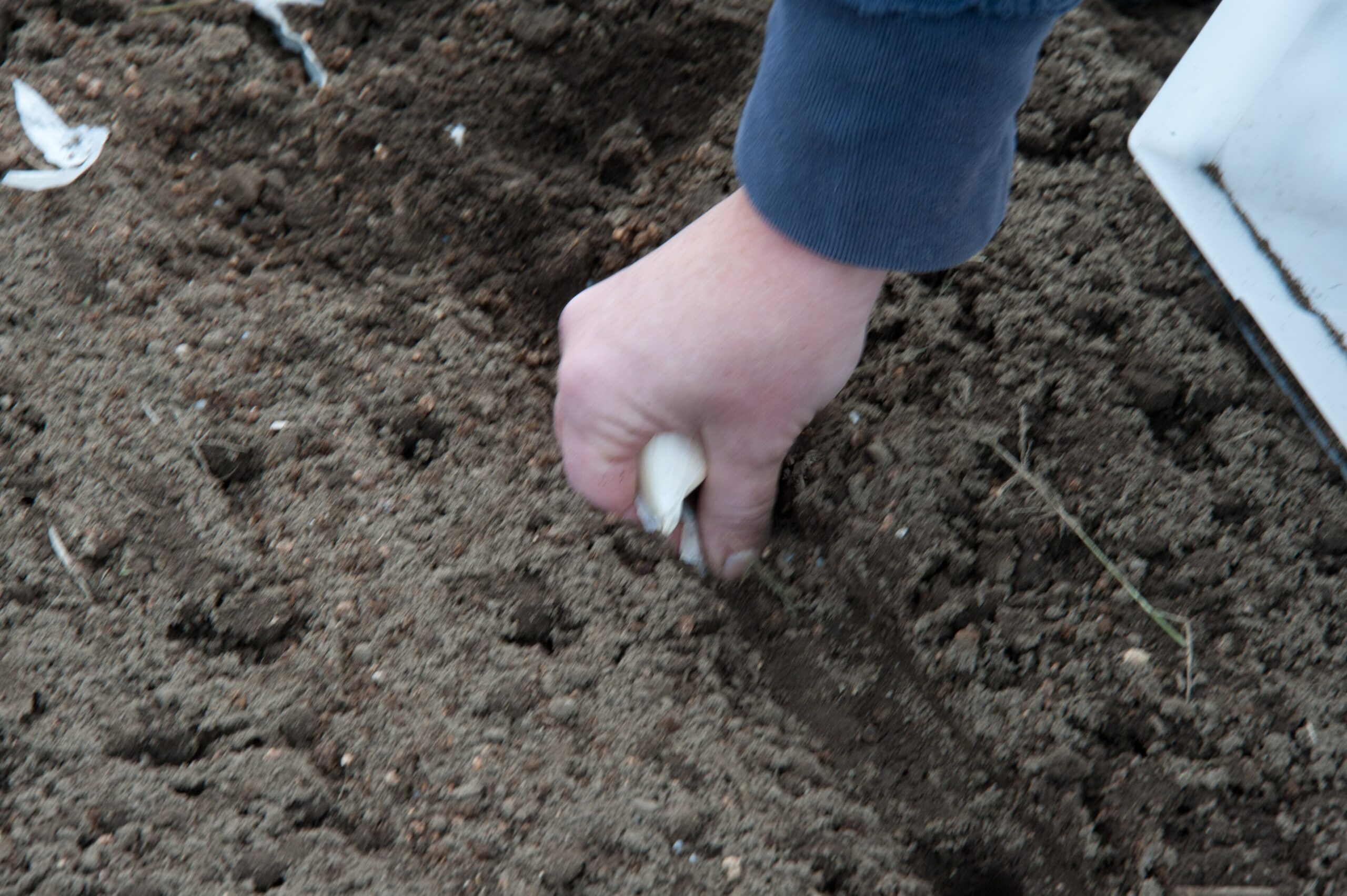
Penn State, Kentucky, North Dakota and Iowa State all set the clove upright, pointed end up. Depth and spacing vary a little by region:
- Penn State: at least 2 inches deep, 4 to 8 inches apart.
- Kentucky: 2 inches deep, 2 to 4 inches apart, in rows 10 to 14 inches apart.
- North Dakota: 2 inches deep, 4 to 6 inches apart, in rows 18 to 30 inches apart.
- Illinois: 1 to 2 inches deep, 4 to 5 inches apart, in rows 15 to 18 inches apart.
- Iowa State: 1 inch deep.
Soil matters as much as spacing. Durham calls for well-drained, slightly acidic soil rich in organic matter, with a pH of 6.5 to 7, and suggests raised beds where drainage is poor. Kalb works an inch of compost and 2 to 3 pounds of 10-10-10 fertilizer per 100 square feet into the bed before planting, then waters deeply so the cloves push out roots before the ground freezes. Penn State adds a rotation rule: at least two years between garlic plantings in the same spot.
Sun is the other requirement. Illinois Extension plants in full sun, in well-drained soil amended with compost, and Penn State likewise calls for full sun and loamy soil. Durham’s raised-bed suggestion is aimed at the same thing: soil that drains.
Four Inches of Straw on Top
Once the cloves are covered, the bed gets a blanket. Penn State calls for a good four inches of straw or shredded leaves, and Kalb uses 4 inches of straw or hay to insulate the soil through winter. Iowa State goes a little thicker, at 4 to 6 inches of weed-seed-free straw to help prevent winter injury. Illinois notes that the straw also keeps frost from heaving the cloves out of the soil.
Durham’s advice is to mulch immediately after planting. On windy sites, Ream lays branches over the bed to keep the straw from blowing away.
In early spring, Iowa State moves the straw to between the rows so the garlic leaves can come through. Gardeners clearing beds this week will find more end-of-season work in the site’s list of outdoor garden jobs to finish before snow arrives and its guide to winter tasks that carry gardeners through to spring.
From Fall Roots to a July Harvest
The wait is long but predictable. A Mid-Atlantic vegetable production guide published by University of Maryland Extension says fall-planted garlic is ready to harvest about the second week of July, when 40 to 60 percent of the leaves have yellowed.
Penn State watches for the same signal. When the leaves start dying back, Ream cuts back on watering, loosens the soil around a few heads to check them, and harvests before the wrappers break down or split. The bulbs then cure for two weeks in an airy, shady spot.
All of that starts with a few cloves pushed into cold soil in the weeks before the ground freezes, and four inches of straw pulled over the top.
Get stories like this by email. Sign up for The Parent Diaries Letter.
This article was produced with AI assistance and edited for accuracy against the sources linked above.
Image: Dwight Sipler from Stow, MA, USA – CC BY 2.0/Wikimedia Commons