A New Tree’s Hole Should Be Twice as Wide as the Root Ball and Drain Within 24 Hours, Say Master Gardeners in Drought-Stricken Angelina County, Texas
Only 0.32 inches of rain fell at the Angelina County Airport in October, which is 3.92 inches below the month’s normal, according to a column by Elaine Cameron, an Angelina County Master Gardener, in the Lufkin Daily News. The county is in severe drought, and the master gardeners still say fall is the right season to get a tree in the ground. Their advice for doing it in dry soil starts with the hole: twice as wide as the root ball, no deeper, and tested for drainage before the tree goes in.
Why Fall Planting Still Makes Sense in a Dry East Texas Autumn
Cameron wrote that “fall and winter are the ideal times to plant trees and shrubs.” Her column noted that the airport’s rainfall total for the year through October stood at 24.72 inches, against a normal of 40.57 inches, and that the long-range forecast calls for a warmer and drier winter.
The reasoning behind fall planting is about roots rather than rain. A Texas A&M AgriLife Extension Service planting bulletin distributed through the Texas Commission on Environmental Quality says plant roots grow any time the soil temperature is 40 degrees or higher, which in much of Texas can mean all winter. That growth lets the root system settle in before the spring surge, according to the bulletin.
The severe-drought label comes from the U.S. Drought Monitor, which sorts dry conditions from D0 (abnormally dry) to D4, the most intense category. Cameron cited the monitor in her column when she described Angelina County’s status. For a homeowner deciding whether to plant now, the practical effect is that a new tree will depend on hand watering for longer than it would in a wet autumn.
Texas Arbor Day falls on the first Friday of November, and the column pointed to a community tree giveaway tied to it. Angelina Beautiful/Clean planned to hand out trees at Lowe’s in Lufkin on Friday, Nov. 6, from 9 a.m. to noon, or until the trees ran out. The column also pointed readers to the Texas A&M Forest Service’s online planting guides.
A Hole Twice as Wide as the Root Ball, and No Deeper
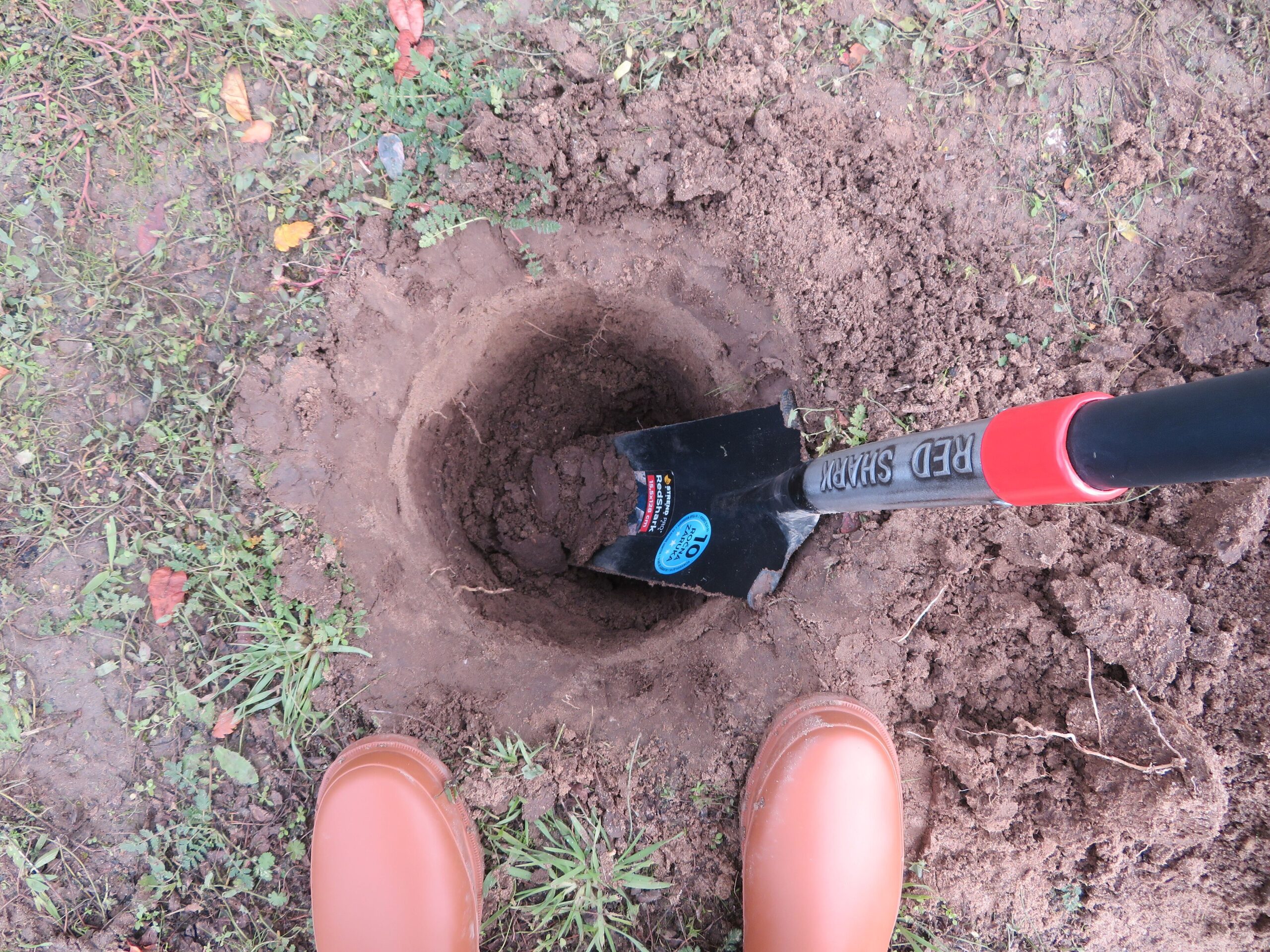
The master gardeners’ first rule concerns space above and below ground. Cameron advised researching a species’ mature size before planting so the tree has room to grow both up and out, then digging the hole twice as wide as the root ball but no deeper.
The Rockwall County Master Gardeners, part of the Texas A&M AgriLife Extension Service, give the same measurement in their 10-step planting guide: twice as wide as the root ball, and no deeper than its height. The guide sets the root collar flush with or slightly above the natural grade. Planting too deep can cause bark to deteriorate at the soil line, while planting too high can keep the tree from taking up moisture and nutrients, according to the guide.
Cameron’s column places the root collar, the thickened area at the base of the trunk, level with the top of the hole. The AgriLife bulletin adds that a plant can sit slightly above the surrounding soil to allow for settling and drainage, and that it should be lifted by the root ball rather than the trunk.
Backfilling uses only the soil that came out of the hole, according to the AgriLife bulletin. Cameron advised watering gently to settle the soil and remove air pockets without packing it down, since packing can damage roots. The AgriLife bulletin recommends holding off on fertilizer until early spring and then applying it lightly.
The 24-Hour Water Test That Decides Whether a Site Works
The step that sets the Angelina County advice apart is the drainage test. Cameron’s instruction is to fill the freshly dug hole with water and check it after 24 hours. If the water has not drained, the column says to pick a different site.
The test matters even in a drought year. Standing water in a planting hole points to soil that will hold roots in saturated conditions after the first real rain, and a tree that survives a dry fall can still struggle in a wet spring. Moving the planting spot is cheaper than replacing the tree.
The Texas A&M Forest Service’s tree planting tools page collects graphics on related decisions, including how to plan for available space, how to plant around a house, how to plant near utility lines and how big a tree will grow. Those topics echo Cameron’s first step, since a drainage-tested hole in the wrong spot, such as under a power line, still produces a problem later.
Berms, Deep Soaks and Mulch for the First Winter
Watering is where drought makes the biggest difference. Cameron advised building a basin 2 to 3 feet across and about 3 inches high around the tree so water does not run off. The basin is filled, allowed to soak in, and filled a second time.
A few days after planting, she wrote, the gardener should dig into the soil and feel a handful. If it is moist, check again in three days; if it is dry, add water. Sandy soil dries out faster and clay holds moisture longer, and temperature and humidity change the schedule too. The goal, according to the column, is evenly moist soil rather than soggy soil, with watering frequency adjusted as the seasons change.
The Rockwall guide lays out a more detailed schedule: daily watering the first week, every other day in week two, every third day in week three, then twice a week for the rest of the growing season, at about 1 gallon per inch of trunk diameter in the first two weeks. It also suggests testing moisture with a long screwdriver, since soil that will not let one go in at least 6 inches is dry.
Larry Stein, a Texas A&M AgriLife Extension horticultural specialist, said in an AgriLife Today article on watering priorities that new plantings are “the most critical” and need water through their first year, even native species, until they become established. He recommended watering at the drip line, in early morning or evening, with a hose, drip system or bubbler rather than a sprinkler.
Mulch finishes the job. Cameron recommended wood chips, pine straw or chopped leaves spread 2 to 3 inches deep and kept away from the trunk, which holds moisture and moderates soil temperature. The Rockwall guide describes the shape as a mulch “donut” rather than a volcano piled against the bark.
In a county that has had barely a third of an inch of rain in a month, the master gardeners’ sequence comes down to a short list: pick a spot with room, dig wide and shallow, confirm the hole drains within a day, and keep the soil evenly moist through the winter.
Get stories like this by email. Sign up for The Parent Diaries Letter.
This article was produced with AI assistance and edited for accuracy against the sources linked above.
Image: Sciencia58 – CC0/Wikimedia Commons