Clemson Extension Says Fescue Lawns Should Be Mowed at 2.5 to 3 Inches in November, Never Losing More Than a Third of the Blade
Fescue is one of the few lawn grasses still in a growth spurt in November, thickening up and sending homeowners back to the mower just as warm-season lawns slow toward dormancy. Clemson University’s Home & Garden Information Center (HGIC) pins down the setting for that cut in its November 2026 monthly garden calendar, published Nov. 6. Samantha McGaha Brown, an Anderson County extension agent writing for the Upstate, says cool-season grasses such as fescue are “beginning to thrive,” and that they should be mowed at about 2.5 to 3 inches.
The same entry sets a limit on how much comes off at once, with mowing frequent enough that no more than one-third of the grass blade is removed. Together, the height and the one-third limit make up the whole November mowing plan for a fescue lawn.
Why Fescue Keeps Growing While Other Lawns Stop
Fescue is a cool-season grass, and fall is its active season. The Clemson calendar’s Midlands entry, written by Jennifer Weaver, treats warm-season lawns very differently. It advises raising the mowing height for warm-season lawns by half an inch to protect them from winter kill, and it notes that the taller cut encourages deeper rooting and suppresses winter weeds.
Gary Crispell, an NC State Extension Master Gardener volunteer in Durham County, describes the same split in his November 4 to-do list. He writes that warm-season lawns such as Bermuda, zoysia and centipede are about to go dormant, while cool-season lawns of tall fescue, bluegrass and perennial rye still need mowing, at 3 to 4 inches in his list.
That difference in range is real. Clemson’s calendar says 2.5 to 3 inches, and Durham’s volunteer says 3 to 4. Extension publications from the two states also vary a little. Clemson HGIC’s tall fescue maintenance calendar gives 2.5 to 3.5 inches for September through November, and NC State Extension’s tall fescue lawn calendar lists 2.5 to 3 inches for the same months, rising to 3 inches from December through February. A fescue lawn that sits anywhere from 2.5 to 3 inches is inside every one of those ranges.
How the One-Third Rule Works at 3 Inches
HGIC’s mowing factsheet states the rule as removing “no more than one-third of the grass height at any one mowing.” Its worked example is a centipedegrass lawn kept at 2 inches, which should be mowed when it reaches about 3 inches.
The same arithmetic applies to fescue. A lawn kept at 3 inches is due for mowing when the grass reaches 4.5 inches, since cutting back to 3 inches takes off 1.5 inches, exactly one-third of the height. A lawn kept at 2.5 inches would be due at about 3.75 inches. Waiting past those points means taking more than a third off in one pass.
Staying inside the limit has a second benefit. The HGIC factsheet explains that following the rule keeps clippings short, so they drop to the soil quickly, and it recommends returning them to the lawn. It describes clippings as containing about 4 percent nitrogen, “basically a 4-1-3 fertilizer.”
The Missouri Botanical Garden’s cool-season lawn guidance makes the same point about frequency. It says more frequent mowing may be required in spring and fall, when growth is most active, and that the one-third rule still applies. For a fescue lawn in a mild November, that means the mower stays on the schedule the grass sets, not the one on the calendar.
The November height also sits well away from the lower numbers other regions publish. Utah State University Extension’s horticulturist, for one, advises a much lower final mow of 1 to 1.5 inches in that state, and the University of Minnesota’s last-cut advice comes with its own snow-mold reasoning, covered in the Minnesota last-mow guidance. Those targets are for the final cut of the year in cold-winter states. Clemson’s 2.5 to 3 inches is for a lawn that is still growing.
Sharp Blades, Leaf Mulch and the Fall Patch to Watch For
Blade condition matters more when the grass is growing fast. According to the Clemson factsheet, a dull blade causes the leaf to turn brown at the point of impact, giving the whole lawn a brown cast, and it advises mowing with a sharp blade.
Fallen leaves are the other November companion to mowing. In the coastal entry of the Clemson calendar, Christiana Huss advises leaving fallen leaves in place or using them as mulch under trees and shrubs, and she specifically says to avoid chop-mulching or removing them. Brown, writing for the Upstate, suggests leaving some leaves in beds as overwintering habitat for beneficial insects and disposing of heavily diseased leaves. NC State’s Crispell says mulching clippings and leaves is preferable to bagging them, and that bagged material belongs in the compost pile, not the landfill. Nearby Chatham County’s extension office makes a similar point in its Leave the Leaves post, written by Master Gardener volunteer Betsy Kraus, which recommends running a mulching mower over the leaves so the ground-up pieces feed the lawn.
Brown also flags a disease to watch for as turf goes dormant: large patch. She describes circular yellow or brown spots that expand, and says cool, wet fall weather can bring them on. Clemson HGIC’s brown patch and large patch factsheet adds that large patch most commonly affects centipedegrass, zoysiagrass and St. Augustinegrass. It says the fungus is active in late fall and again in spring, and that most visible symptoms show up in spring as lawns green up. In other words, a fescue owner who sees spreading patches in November is likely looking at a problem worth identifying properly before treating, and a county extension office is the usual place to take a sample.
The factsheet’s cultural advice is the part that applies to any lawn: regular mowing at the proper height, since cutting too low or too high increases disease, and watering only when needed, early in the morning.
Feeding is the one other fescue lawn job that November touches. The Clemson tall fescue calendar calls for 1 pound of actual nitrogen per 1,000 square feet in September and, optionally, again in November, preferably based on a soil test. NC State Extension’s calendar lists the November application at the same 1 pound per 1,000 square feet and says to apply it when the grass is green but not actively growing. Brown’s own November entry for the Upstate does not mention fertilizer, and state fertilizer rules differ, so the lawn’s local county office is the place to confirm a date; a nearby example is how extension experts separate cool-season from warm-season lawns on late-fall nitrogen.
This article was produced with AI assistance and edited for accuracy against the sources linked above.
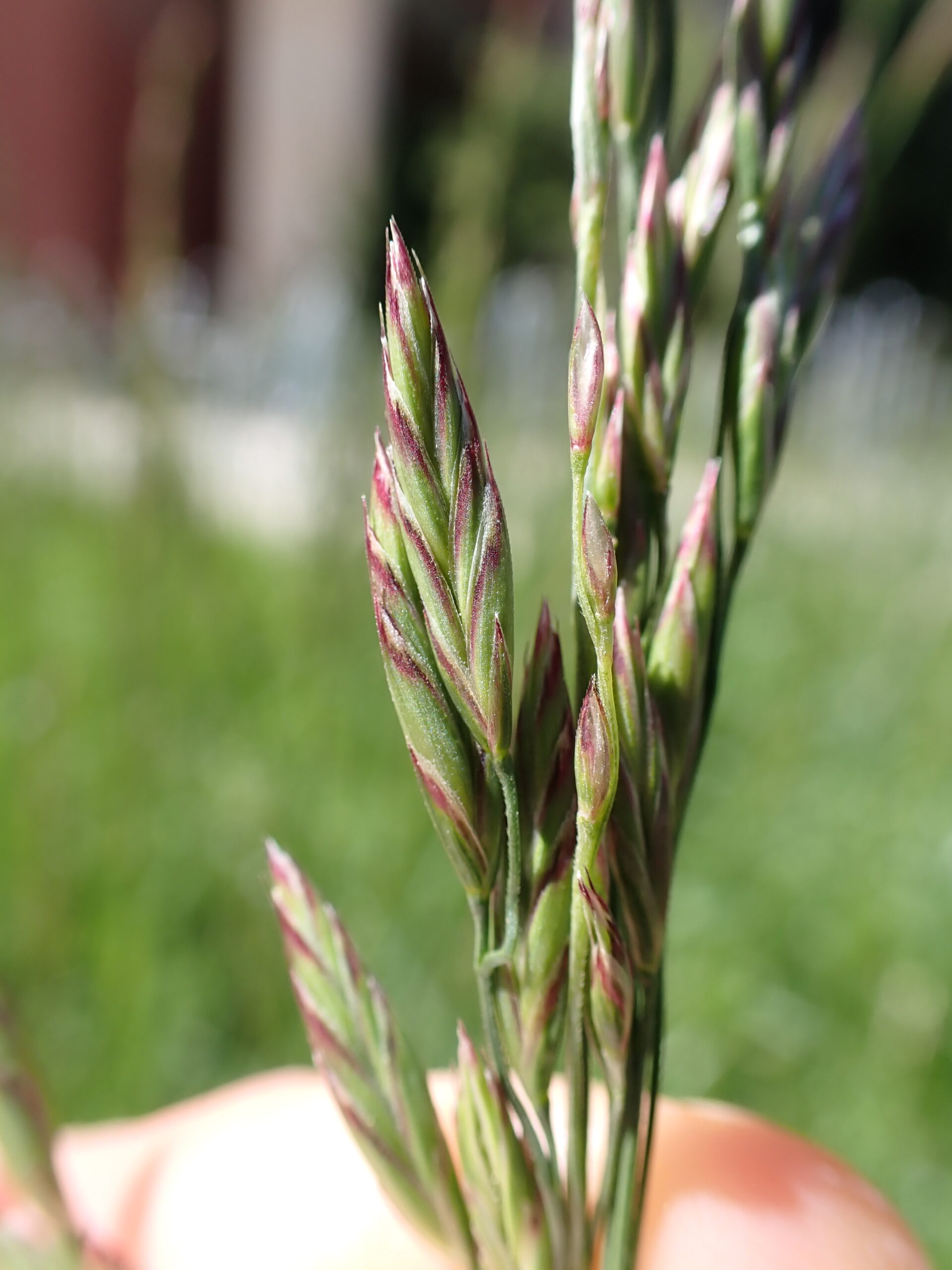
Image: “Schedonorus arundinaceus – tall fescue – 53079632868” by Matt Lavin is licensed under CC BY-SA 2.0. To view a copy of this license, visit https://creativecommons.org/licenses/by-sa/2.0/.