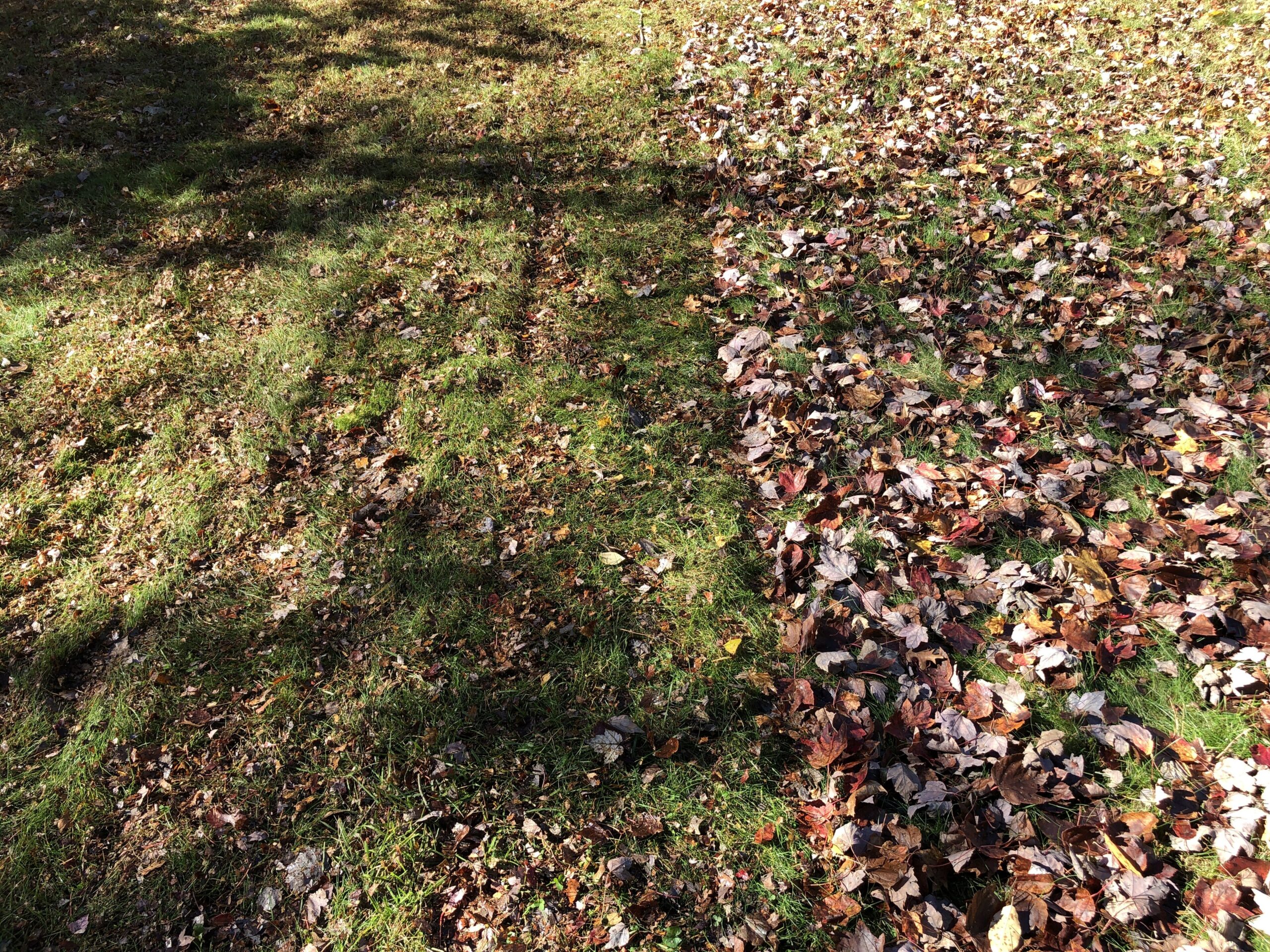
Mowing Fallen Maple Leaves Into the Lawn in November Gave About 80% Dandelion Control in Michigan State University Research
Raking maple leaves off a lawn in November may be clearing away the very thing that keeps next spring’s dandelions down. In Michigan State University trials, leaves mulched into Kentucky bluegrass with a rotary mower cut dandelion populations by about 80 percent at the highest rate used, according to the university’s published research report.
The result comes with conditions that decide whether a home lawn can expect the same. The numbers below are from plots that were intentionally kept weak, and the researchers say mulched leaves are not a stand-alone replacement for herbicides.
Eighty Percent, With Conditions
The report, titled “Mulched Maple and Oak Leaves Associated with a Reduction in Common Dandelion Populations in Established Kentucky Bluegrass,” was written by Alexander Kowalewski, Douglas Buhler, N. Suzanne Lang, Muraleedharan Nair and John Rogers III of Michigan State. It appeared in the April-June 2009 issue of HortTechnology.
After one leaf application, dandelions dropped by up to 80 percent at the high rate in 2004. After two applications, the reduction measured in 2004 and 2005 was up to 53 percent. The State News, MSU’s student newspaper, reported in 2009 that test plots had about 80 percent fewer dandelions in the first year and about 50 percent fewer in the second.
How the Michigan State Plots Were Set Up
The work was done at the Hancock Turfgrass Research Center in East Lansing on ‘Fylking’ Kentucky bluegrass planted in 1992. The researchers sprayed a broadleaf herbicide in August 2003 to clear weeds, scalped the turf to 1 inch, and sowed common dandelion seed in September. They first applied leaves on Oct. 31, 2003, and mowed them in on Nov. 5 at 2 inches with a rotary push mower.
Leaves came from pesticide-free tree plantations. Two rates were tested, 0.5 kilogram per square meter, similar to a natural leaf fall, and 1.5 kilograms per square meter, which a Turf & Rec account of the research says is about 5 centimeters of cover. Plots with no leaves served as the comparison.
Spring green-up also improved. The report says the high rate gave the best color ratings regardless of tree species, followed by the low rate and then the bare control.
Which Leaves Worked Best
Five kinds of leaves were tested: red maple, silver maple, sugar maple, a high-sugar strain of sugar maple and red oak. The report ranked red oak as the most consistent at controlling dandelions, followed by sugar maple and the high-sugar sugar maple, then silver and red maple. Fine and coarse leaf pieces made no significant difference in dandelion counts.
The Turf & Rec article, which covered Kowalewski’s March 2011 presentation at the Canadian International Turfgrass Conference, said sugar maple performed best in the 2003 to 2005 trial. Kowalewski described maple leaf mulching as a strong case for lawns and city green spaces, especially where conventional herbicides are restricted.
Mowing Directions From Illinois Extension
For a home lawn, Illinois Extension’s Travis Cleveland summarized the Michigan State findings in October 2022. A six-inch-deep layer of maple and oak leaves could be mulched into established turf with no apparent adverse effects, he wrote, and decomposing leaves supplied nutrients that promote quicker spring green-up.
Cleveland’s directions are short. Set the mower to its highest setting and mow as usual, then make a second pass at a 90-degree angle if the leaf layer is deep. Some leaf residue will remain visible and break down over winter and early spring. He suggests easing into the method by alternating between mulching and bagging, then using bagged leaves as mulch in landscape beds and vegetable gardens.
A Michigan State University Extension bulletin, reproduced by Waterford Township, adds that the best results come from a mulching mower, a raised mowing height and dry leaves. Lawn owners who want to keep the pieces in garden beds instead can follow the shredded-leaf mulch method for garden beds.
What the Research Does Not Promise
The authors cautioned that their results “do not suggest that mulching leaves can be used exclusively as an alternative to herbicides” for high-quality weed control. Dandelion counts stayed under 100 plants per plot but rose over time, because the turf was kept weak on purpose to encourage them. Proper mowing, fertilization and irrigation remain important for a competitive lawn, the report says.
Trey Rogers, the MSU crop and soil sciences professor who oversaw the project, told The State News that leaf mulching alone will not continually reduce weeds like dandelions, and that lawn care practices “go hand in hand.” The Turf & Rec article noted that control was lost by the second year in the low-maintenance trial, and that the chemical responsible for the effect has not been identified.
The same newspaper reported that MSU Landscape Services stopped hauling leaves to a campus compost site around 1999 and began mowing them into the soil, which landscape services coordinator Steve Frank said saves the university about $30,000 a year in leaf cleanup costs.
Get stories like this by email. Sign up for The Parent Diaries Letter.
This article was produced with AI assistance and edited for accuracy against the sources linked above.
Image: Famartin – CC BY-SA 4.0/Wikimedia Commons