Dahlia Tubers Dug About a Week After the Stalks Are Cut and Stored at 40 to 50 Degrees Can Be Replanted Next Spring
The first hard frost turns dahlia leaves black almost overnight, and in most northern gardens that is the signal the season is done. The plants are finished for the year, but the tubers under them are not.
In cold-winter areas, dahlia tubers left in the ground freeze or rot. Iowa State University Extension, Washington State University Extension, the University of Kentucky and the American Dahlia Society lay out the same basic plan for saving them: cut the plants down, wait about a week, dig the clumps, and keep them cool and dry until spring planting.
Cut the Stalks, Then Wait About a Week
The work starts with the pruners, not the shovel. Iowa State’s Yard and Garden team says to cut the plants down first and then leave the dahlias in the ground for an additional six or seven days to “cure.”
Kathy Wolfe, writing for WSU Extension, cuts the stalks to about 6 inches above the ground after a hard frost or by mid-November, then waits at least a week before digging. The pause lets the eyes of the plant develop, which makes the clumps easier to divide. WSU recommends digging and storing in zones 3 through 6, and for any prized variety a gardener doesn’t want to lose.
There is no need to rush the first light frost, either. Rick Durham, an extension professor of horticulture at the University of Kentucky, writes that the roots keep maturing through a light frost and often through the first hard freeze, so it is often best to give them more time in the ground.
Lifting the Clumps Without Breaking the Necks
The neck, where each tuber joins the old stem, is the fragile part. Wolfe and Durham both dig on all four sides of the plant, about a foot from the stalk, and lift the whole clump carefully so the necks don’t break.
Once a clump is out, Wolfe washes off the soil with a garden hose and trims away the feeder roots and the long, tapered roots. Alan Fisher of the American Dahlia Society explains why the washing matters: soil carries microorganisms, so he removes as much dirt as possible and rewashes after dividing.
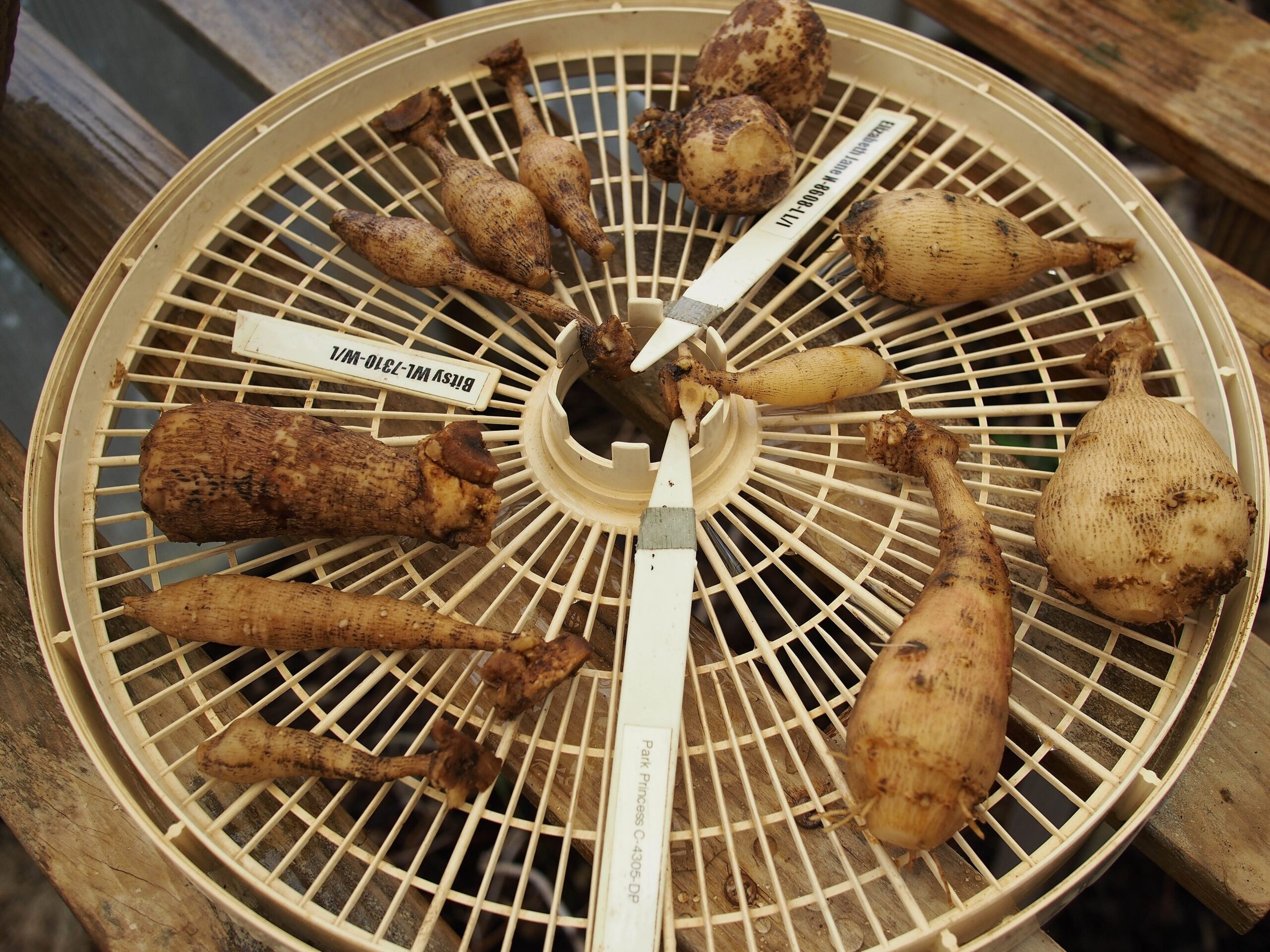
This is also the moment to label. WSU suggests marking each variety with a permanent marker, on a tag or directly on the tuber, since names are easy to forget once several clumps are lying side by side.
Drying and Dividing Before Storage
Wet tubers packed straight into a box are an invitation to rot. Wolfe dries the clumps overnight in a cool, dry, shaded spot and warns against leaving them in the sun. Iowa State lets clumps dry for 24 hours before packing, and the university’s guide to overwintering tender perennials puts it simply: let the roots dry until they feel dry to the touch, usually about a day.
Dividing in fall saves storage space. WSU’s guide uses a sharp paring knife or a hooked-blade knife to cut each tuber away from the main stalk, making sure every piece keeps an eye, the small swollen dot at the base of the old stem. Fisher removes all of the old stem, because any left behind tends to promote crown rot, and he sterilizes the knife between clumps with one part bleach to ten parts water.
The cut ends need time to seal. Durham says drying can take between 24 and 36 hours depending on temperature, humidity and the size of the cut.
Holding the Tubers at 40 to 50 Degrees
Temperature decides whether the tubers make it to spring. Iowa State recommends a cool, dry location between 40 and 50 degrees Fahrenheit, with the clumps set upside down in cardboard boxes and covered with vermiculite, peat moss or wood shavings. The American Dahlia Society notes that most growers aim a little tighter, at 40 to 45 degrees, always above freezing and never warm enough to trigger early sprouting.
The packing material is where the sources differ. WSU lists mesh bags, peat moss, sand, or pet bedding such as sawdust or shavings, and says to skip potting soil. Durham and Fisher both point to coarse vermiculite in plastic bags as a preferred method, and Fisher advises against peat moss and perlite. The goal in every version is a medium that holds a little moisture without staying wet.
Stored tubers still need attention. Wolfe and Fisher check them monthly and pull any that are rotting before it spreads, and Durham also watches for mice and other rodents. Storage that runs too warm leaves tubers shriveled, and storage that runs too cold leads to freezing or rot.
The same cleanup that frees up the dahlia bed is a good time to plan the rest of the border, and the site’s roundup of fall flowers for lasting color covers what can fill the gap. Gardeners where the weather service has already called the season, like Frederick, Maryland and western Loudoun County, can start digging now.
Spring Replanting, and Where Dahlias Can Stay Put
The payoff comes in spring. WSU’s guide keeps only tubers with an eye. About six weeks before the plants go outside, it starts them in potting soil or sand, 2 to 3 inches deep, in a warm spot above 60 degrees. After the last frost, the tubers go into holes about 6 inches deep, with stakes set about 2 inches away before planting so a stake driven in later doesn’t pierce them.
Not every garden has to lift its dahlias at all. WSU says that in zones 8 through 10, where winter lows rarely drop below 20 degrees, gardeners can cut the plants to the ground and leave them. In zone 7, leaving them can work in a mild winter with well-drained soil, under a few inches of mulch, leaves, straw or compost and a sheet of plastic against winter rain, with the extra layers pulled off in March.
Everywhere colder, a week of patience after cutting, a careful dig and a box kept between 40 and 50 degrees carry a favorite dahlia through to next spring. More cold-weather jobs are in the site’s list of outdoor garden jobs to finish before snow arrives.
Get stories like this by email. Sign up for The Parent Diaries Letter.
This article was produced with AI assistance and edited for accuracy against the sources linked above.
Image: F. D. Richards – CC BY-SA 2.0/Wikimedia Commons