Small Pots of Evergreens Should Sit Against a Wall Under Mulch or Shredded Leaves and Keep Getting Water All Winter, HGTV Says
Roots in a pot face a colder winter than roots in the ground, and that is why small potted evergreens get special treatment. HGTV’s winter-protection checklist says small pots of evergreens should sit against a wall under mulch or shredded leaves and keep getting water all winter. The advice appears in the same HGTV gallery that covers compost bins and mowers, and it comes with a few related chores for pots, beds and tropical plants.
The page notes that evergreens in large pots may survive mild winters, but small pots need protection. Extension specialists at Penn State, Illinois and Colorado State give the reasoning and some numbers.
Why small pots need the wall and the mulch
A pot holds only a small amount of growing mix, and that mix cools quickly. Ken Johnson of University of Illinois Extension explains in a Nov. 18, 2020 Good Growing post that potted plant roots face colder conditions than roots in the ground. A common rule of thumb, he writes, is to choose plants hardy two zones colder than the local zone, which in central Illinois means plants rated for zones 3 or 4.
Barb Ryan, a Penn State Extension Master Gardener, makes the same point in an article updated Oct. 12, 2026. Hardiness zones describe plants growing in the ground, she says, and container roots can get as cold as the winter air. Larger pots provide more insulation.
That is where a wall helps. Colorado State Extension’s PlantTalk advice is to cluster containers against the house on the north or east side, under the eaves, if sinking pots into the ground is not possible. Johnson also lists the north or east side of a building, away from strong winds and intense sun.
What goes on top of the pots
HGTV says to cover the pots with mulch or shredded leaves. Colorado State gives depths: mulch sunken pots 6 to 12 inches deep with straw, leaves, hay or shredded bark. For clusters, it says to put larger pots on the outside and smaller ones on the inside, surround the group with thick mulch or hay bales, and mulch over the pot tops.
Ryan lists straw, compost, shredded leaves, bark mulch, evergreen boughs or a thermal blanket for grouped pots in a sheltered spot. Single pots can go inside a box or wire enclosure lined with bark mulch, straw, packing peanuts or bubble wrap. Clay, ceramic and glazed pots that must stay outside should be wrapped in insulation and covered with plastic, since they can crack.
Johnson says to use straw, leaves or wood mulch, applied heavily to grouped pots or pots sunk in the ground, and to remove it once growth resumes in spring. Colorado State and Penn State both advise removing covers gradually so plants can readjust.
Water all winter, even when growth stops
The second half of the HGTV instruction, keeping the pots watered through winter, may be the one most often skipped. Illinois Extension’s container gardening page says watering needled and broadleaf evergreens, such as hollies, boxwoods and ivy, is essential in winter, and that the main goal is to keep the soil from freezing and moist all winter.
Johnson gives the reason. Evergreens are especially vulnerable to desiccation, or winter burn. Roots keep taking up water after top growth goes dormant, and moist growing media freezes more slowly than dry media. Ryan adds that dry soil freezes faster than moist soil, and says to water well before the soil freezes and to check moisture in stored pots without overwatering, to prevent root rot.
Colorado State sets a schedule: water pots thoroughly before winter, check sunken pots monthly and clustered pots every two weeks, and check pots in a garage or shed frequently. It says to start winterizing in November, or when the soil has cooled. Ryan also mentions anti-desiccant spray or a wind screen as protection for evergreens.
Other places a pot can spend the winter
A wall is not the only option. Ryan says an entire pot can be buried in the ground with mulch over the soil, or smaller pots can move to an unheated garage, shed, cold frame or basement. Johnson puts the target range for unheated storage at about 20 to 45 degrees, a method that works best for plants that are not hardy in the local zone.
Sinking pots is another route, he writes, because the surrounding soil insulates the pot and roots. The pots come out once the danger of hard frost passes. HGTV’s checklist also reminds gardeners not to let the root balls of in-ground evergreens dry out completely.
The rest of HGTV’s pot list
HGTV’s checklist has more to say about pots and beds. It says to use a mulch layer 2 to 4 inches deep in the perennial border, and to mulch again once temperatures stay consistently cold. Pots that will not be left outside should have the soil emptied out, because it can crack them, and can be scrubbed with one part bleach to nine parts water.
The same page says tropicals should come inside before temperatures drop below 45 degrees. They get sprayed for pests such as spider mites, aphids and mealybugs first, and a neem oil solution works well. Watering is cut back and fertilizer withheld until next spring.
Johnson and Illinois Extension agree that containers holding soil can suffer from freezing and thawing. Large concrete and wooden planters generally survive northern Illinois winters without being emptied, the container page says, while other containers should be emptied of soil and plants and stored upside-down. Readers can find more on pot choices in this site’s earlier note on perennials spending winter in pots.
This article was produced with AI assistance and edited for accuracy against the sources linked above.
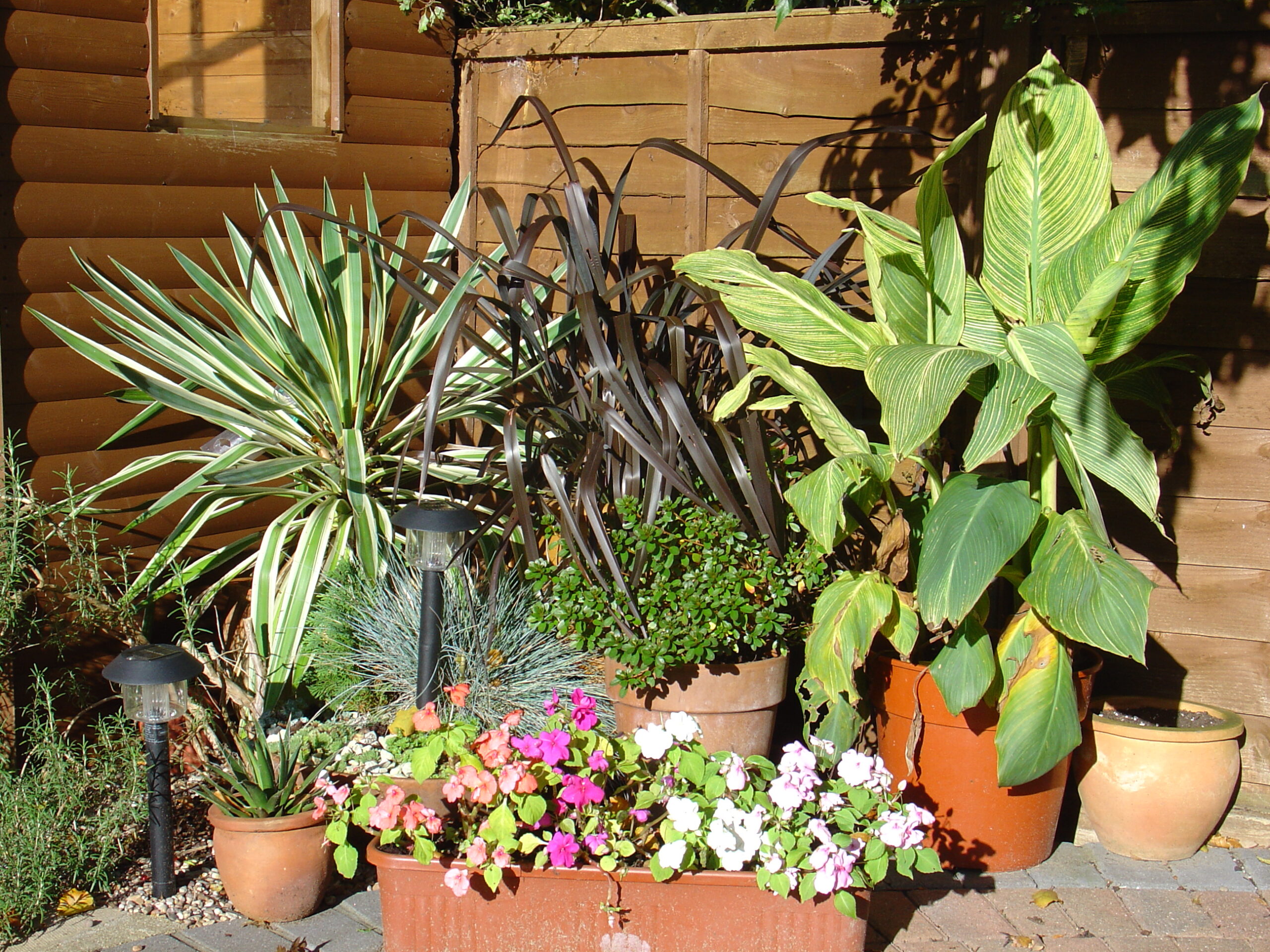
Image: “Patio pots (61553005)” by Andy / Andrew Fogg is licensed under CC BY 2.0.