Fall Is the Easiest Time to Spot Invasive Bittersweet, Buckthorn and Burning Bush, UNH Extension’s Jo Russavage Says, and Vines on Big Trees Get Cut at Knee Height
Invasive shrubs and vines are easiest to find in the fall, when the traits that help them outcompete native plants turn into giveaways. Jo Russavage of UNH Extension makes that case in an Oct. 13 post naming bittersweet, buckthorn, honeysuckle and burning bush as plants that show themselves once the surrounding woods change color. For vines that have climbed large trees, she recommends cutting them at knee height.
What Stands Out in the Fall Woods
Russavage writes that many invasives change color on a different schedule from natives. Some stay green later in the season, some leaf out earlier in spring, some hold their leaves after native plants have dropped theirs, and others ripen conspicuous fruit. Together, those habits make plants visible from a distance in fall that blended into the canopy in summer.
Buckthorn is a good example. It stays green late into fall and leafs out early in spring, so it is visible at both ends of the season, and its berries are hard to miss. Honeysuckle also holds its green longer than native shrubs, with red berries that show in the photos accompanying the post.
Burning bush does the opposite. It keeps bright red foliage long after other plants have dropped their leaves, so it stands out in the understory or mid-canopy. The post also points to autumn olive and privet, whose fruits ripen in fall and are easy to spot, Norway maple with its distinctive yellow leaves, and Japanese barberry with its own distinctive fall color.
The post adds two light notes. Russavage says autumn olive fruit makes great jelly, while privet berries are for wildlife, not people.
She also describes a plant that is not on New Hampshire’s invasive list but behaves badly: an unwanted spirea. It turns red in fall and is “quite visible amongst the now pale ferns” in the woodland understory. She says it seeds freely and comes up everywhere, and although she removed the parent plant years ago, new seedlings still emerge each year, so she stays watchful.
Bittersweet: Yellow-Green Leaves and a Knee-High Cut
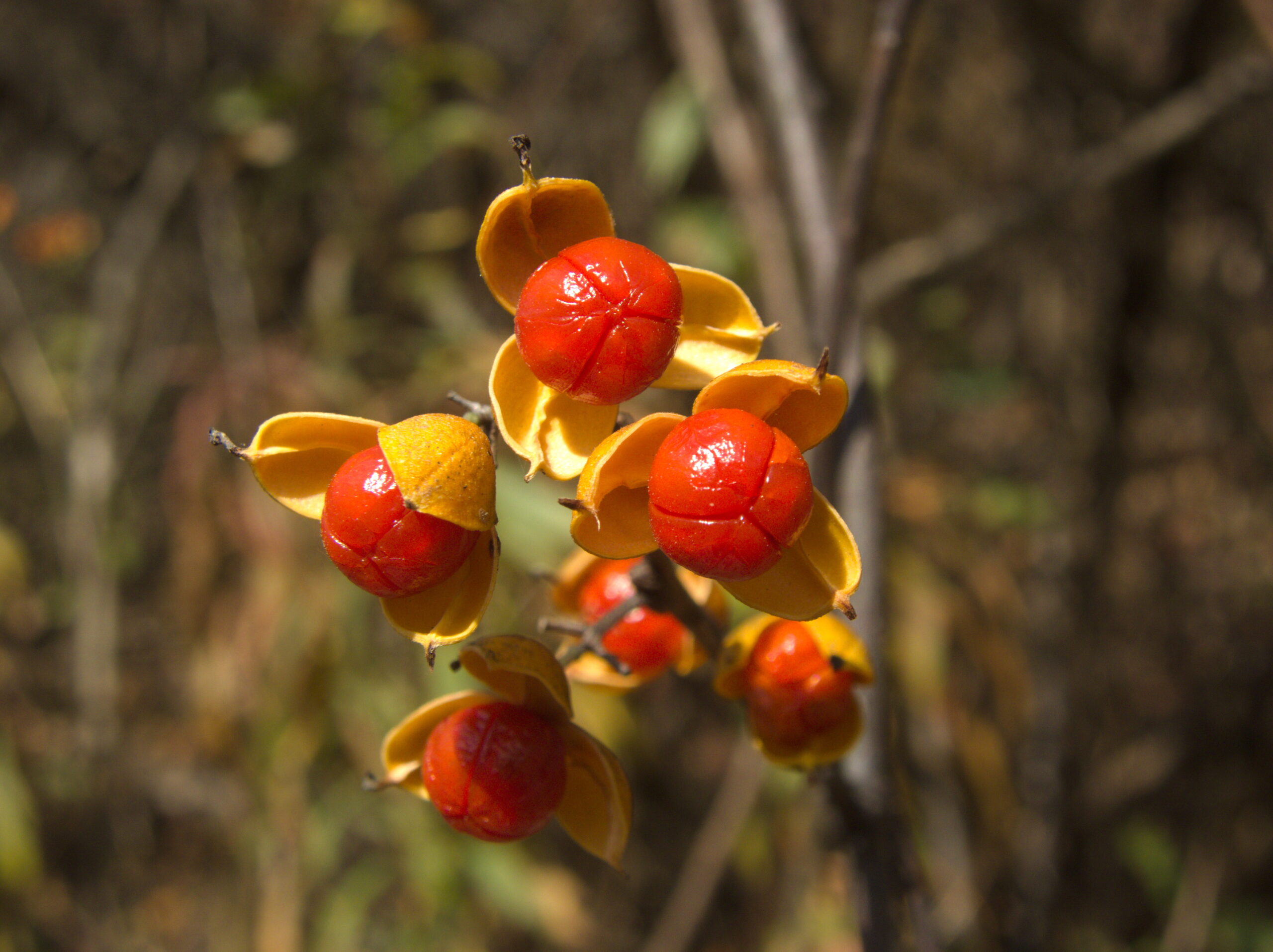
Bittersweet vines blend into the canopy in summer, Russavage writes, because their leaves are green like everything around them. Leaf margins begin to yellow as fruit develops, and by October the leaves are a bright yellow-green that stands out against native fall color. Yellow berries are visible in the October photos in her post, which contrast with September images showing green leaves.
The vines can damage the trees they climb. The post says stem damage can show up on the host tree, and heavy growth can produce shaggy canopies that hide the natural form of the tree. One photo shows a dead apple tree serving as a trellis for bittersweet.
For large trees covered in vines, her instruction is to cut the vines at knee height. Doing so keeps “all that energy from going back to the roots,” and the post says to plan on managing regrowth next season.
New Hampshire also prohibits Oriental bittersweet (Celastrus orbiculatus) outright, according to the text of the state invasive species rules, so the vine Russavage describes is a regulated plant, not just a nuisance.
What New Hampshire’s List and Rules Say
New Hampshire’s rules, adopted under RSA 430:55 and last effective in January 2017, prohibit more than the species in Russavage’s post. The prohibited plants include Norway maple, autumn olive, burning bush, glossy buckthorn, common buckthorn, Japanese barberry, European barberry, Oriental bittersweet, several honeysuckles and two privets, according to those rules.
The rules bar anyone from collecting, transporting, importing, exporting, moving, buying, selling, distributing, propagating or transplanting a living, viable portion of a listed plant, including all cultivars and varieties. Fines run $100 for a first offense, $200 for a second, $300 for a third and $1,000 for a fourth or later, and the commissioner may also order eradication or control measures. Listed species must be disposed of so they are nonliving and nonviable, the rules say.
The rules do not, however, require anyone to pull out plants already growing on their land, according to UNH Extension’s fact sheet on alternatives to invasive landscape plants. That sheet notes that the 2017 prohibited list includes 35 upland species and that three were once popular landscape plants: burning bush, Japanese barberry and Norway maple.
For gardeners replacing a burning bush, the same fact sheet suggests native highbush cranberry with burgundy fall foliage, highbush blueberry, red chokeberry with red berries and fall color, redvein enkianthus, and fothergilla, which turns yellow, orange and red. Weigela, slender deutzia, Atlantic ninebark and shrub roses stand in for barberry, though it warns against roses grafted onto multiflora rose rootstock, since multiflora rose is prohibited. Red maple, northern red oak and ginkgo are listed as replacements for Norway maple. No single plant fully replaces an invasive one, the fact sheet cautions.
The state agriculture department’s invasive species FAQ names Norway maple, Japanese barberry and burning bush as invasive landscape plants and points readers to its Prohibited Invasive Species Fact Sheet for the full list. Questions go to Douglas Cygan, the department’s invasive species coordinator, at (603) 271-3488.
Local conservation groups publish more hands-on advice. A Monadnock-region brochure from the Peterborough Conservation Commission and Open Space Committee, posted by the town of Jaffrey, says Oriental bittersweet can climb to 60 feet and smother what it grows on, and that its seeds and orange rootlets build up in the soil and can stay dormant for years. It describes glossy buckthorn as a small tree with shiny leaves and white dots on its bark, whose cut stumps resprout with multiple stems, and burning bush as a former landscaping favorite with corky “wings” on its green stems.
The brochure stresses early detection, since removal is far easier before an invader reaches high density. It suggests cutting plants after they leaf out to deplete their energy and repeating the cutting, covering a cut patch with plastic, stripping berries or cutting flower heads to stop seed spread, and revisiting treated sites for several years to catch resprouts. Herbicides, it notes, should be applied carefully in late summer, and under New Hampshire rules a state-licensed applicator must apply them unless the property owner does it.
This article was produced with AI assistance and edited for accuracy against the sources linked above.
Image: “Celastrus orbiculatus, Montour Trail, 2024-10-31” by Cbaile19 is released under CC0 (Wikimedia Commons).