A Woman Agreed to Water Her Friend’s Beloved Calathea for Three Months, Then the Plant Started Dying Despite Her Following Every Care Instruction
A person shared her story about agreeing to look after two houseplants while a friend traveled to her home country for three months. One was a money tree, while the other was a beautiful calathea that clearly required much more attention. The friend provided detailed instructions, so the person assumed keeping them alive would be a straightforward favor.
The watering routine seemed almost impossible to misunderstand. She was given distilled water and even received a cup showing exactly how much water each plant needed. The lights were automatic, the friend had chosen where the plants should sit in the apartment, and the person promised to follow the schedule carefully.
Everything Went Fine at First
For the first month, nothing seemed wrong. Both plants looked healthy, and the person had every reason to believe she was handling the responsibility properly. She watered them on schedule and never knowingly deviated from the instructions.
The calathea seemed especially happy at first, which made what happened later even more confusing. There were no obvious warning signs that something was slowly going wrong beneath the surface. Then, sometime after the second month began, the leaves started changing.
The Calathea Suddenly Looked Sick
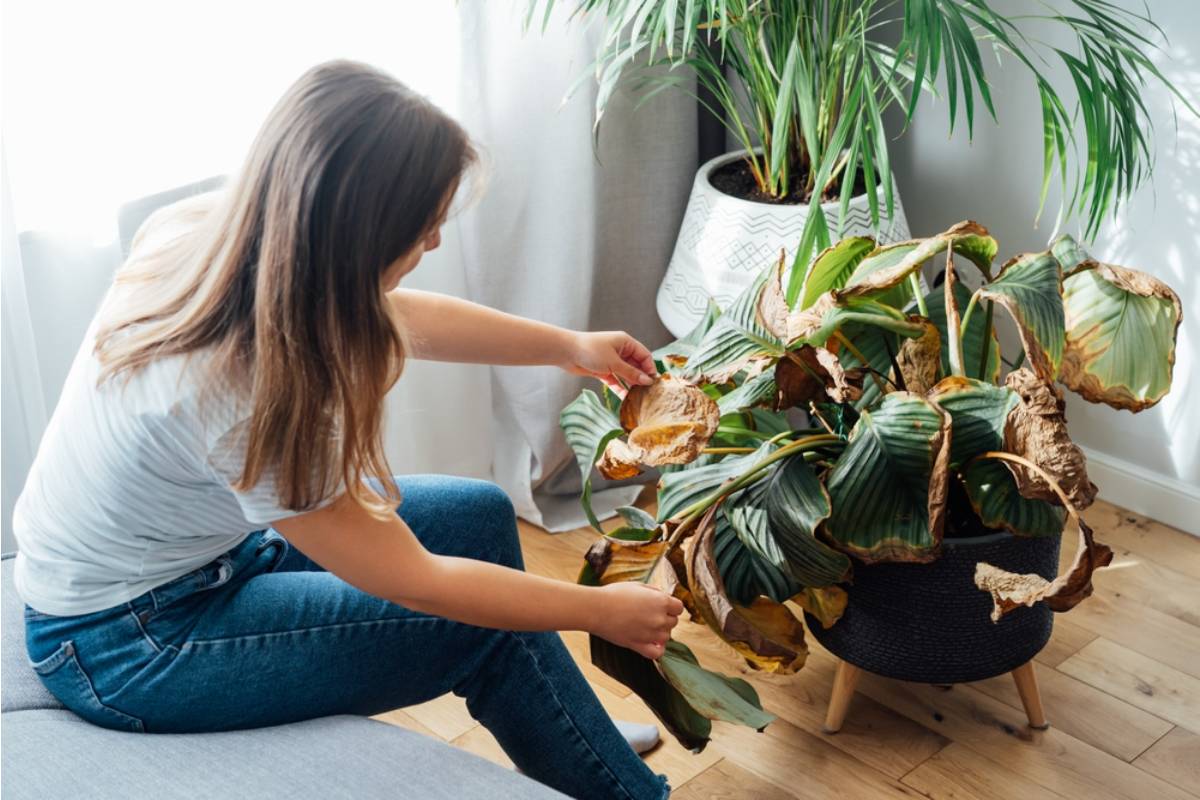
The first signs were wilting and brown leaves. Instead of looking like the lush plant her friend had left behind, the calathea began appearing increasingly miserable. The person immediately started wondering whether she had somehow caused the problem.
She searched for possible explanations and quickly found information connecting brown leaves with unsuitable water. That sent her straight back to the one detail she was absolutely certain about. She had used distilled water every time.
She Had Followed Every Instruction
The person insisted that she hadn’t missed a watering day. She had maintained the Sunday schedule, measured the water carefully, and never intentionally substituted tap water. Even the lighting was controlled automatically, so there didn’t appear to be much room for human error.
Yet the plant was still declining. The person began wondering whether something about her apartment was making the calathea unhappy. The idea became almost personal, as if the plant had decided it simply hated the air around her.
Then She Had to Tell Her Friend
When the person noticed how bad the plant had become, she knew she couldn’t keep quiet. She told her friend what was happening and explained that the leaves were turning brown despite everything she had done. Instead of immediately blaming her, the friend sounded deeply disappointed.
Then came the question that hurt the most. The friend asked whether she was absolutely certain she hadn’t given the calathea tap water. The person reassured her repeatedly, but hearing the question more than once made her feel as though her careful effort was being doubted.
The Guilt Started Growing
The person already felt terrible because she knew how much her friend loved the plant. Hearing disappointment in her friend’s voice made the situation even worse. She wasn’t worried about being blamed for a household decoration, but she hated the thought that something precious to her friend might have been ruined while under her care.
That guilt was especially frustrating because she had genuinely tried to do everything correctly. She hadn’t forgotten the watering schedule or ignored the instructions. If the plant was dying, she couldn’t understand what she had done wrong.
Other Plant Lovers Offered Another Explanation
A response from a person pointed out that calatheas can be extremely difficult to maintain. Humidity, soil moisture, temperature, fertilizer, light, and changes in the surrounding environment can all affect their condition. The person was reminded that caring for a plant for three months in a completely different home isn’t necessarily the same as caring for it in its usual environment.
Another response suggested checking the soil rather than blindly following the calendar. If the soil remained wet after watering, the plant could potentially be dealing with a completely different problem than the one the person had discovered online. Suddenly, the mystery became much bigger than the question of whether distilled water had been used.
Moving House May Have Changed Everything
Several responses focused on one overlooked detail. The calathea had been moved from its normal home into someone else’s apartment, meaning its entire environment had changed at once. Temperature, humidity, airflow, sunlight, and even the surrounding atmosphere could be different despite the careful instructions.
That possibility gave the person some relief. The plant hadn’t necessarily been damaged by anything she had deliberately done. It might simply have been struggling with the transition, especially if it was accustomed to conditions that were difficult to reproduce in another home.
Calatheas Had a Reputation to Defend
The responses quickly turned humorous whenever people discussed calatheas. A response from a person described them as notoriously dramatic plants that could react badly to tiny changes in their surroundings. Too much water could supposedly cause trouble, while too little could do the same, and even humidity or temperature changes could send them into decline.
Another person joked that calatheas seemed determined to find reasons to die. That description made the original poster laugh because the more she researched the plant, the less confident she became about doing anything at all. She began wondering how anyone managed to keep one alive for more than a few months.
Even Fertilizer Became a Risk
Someone suggested that the plant might need fertilizer, but the person immediately rejected the idea. She was already terrified that she had accidentally harmed the calathea and didn’t want to introduce another product that could potentially make things worse. Her approach became increasingly cautious as the plant’s condition declined.
She explained that she wasn’t a plant person and didn’t feel qualified to experiment with chemicals or specialized treatments. Another response agreed that she wasn’t obligated to become an expert overnight simply because she had agreed to water someone else’s plants. The safest course seemed to be getting proper advice before making another major change.
The Internet Offered a Possible Rescue
A response from a person suggested posting photographs of the plant in a plant-care community so experienced gardeners could examine the symptoms. That idea gave the person something concrete to try without requiring her to guess at a treatment. She soon found a community dedicated to calatheas and planned to ask for help.
Other responses suggested that the plant might still be salvageable. One person even recommended rooting healthy leaves or cuttings so the friend might have something to replant if the main plant failed. What initially looked like the end of the calathea’s story suddenly had a possible backup plan.
Then Someone Suggested Talking to the Plant
One particularly unexpected response suggested that the person talk to the calathea. The idea was that plants might respond to sound or positive attention, leading the person to wonder what on earth she was supposed to say to a houseplant. The suggestion was clearly more unusual than checking soil moisture or humidity.
The person jokingly wondered whether the plant might understand Spanish because her friend and her friend’s mother both spoke Spanish. She considered the possibility that the calathea was simply confused by hearing English in its new home. The gardening mystery had officially reached a ridiculous new level.
The Plant May Have Missed Its Original Home
Another person offered a more practical explanation for the plant’s decline. Before the trip, the friend and her mother had apparently been the ones caring for the plants, meaning the calathea was accustomed to their home and routine. Moving it into a different apartment could have disrupted conditions that had previously seemed perfectly normal.
That explanation also made sense of the timing. The calathea had survived the first month, but stress from an environmental change doesn’t always become obvious immediately. The plant could have been struggling gradually while still appearing healthy enough to fool everyone at first.
The Money Tree Became an Important Clue
Interestingly, the second plant wasn’t reported to be suffering in the same way. The money tree continued receiving the same basic care while the calathea deteriorated. That difference suggested that the problem might be less about the person providing care and more about the calathea’s particular temperament.
If the same caretaker could keep one plant looking healthy while another struggled, blaming the caretaker became much harder. The calathea might simply have been far more sensitive to its surroundings. In that sense, the money tree quietly became the most convincing witness in the entire case.
The Responses Eventually Cleared Her Name
By the end of the discussion, the responses were overwhelmingly sympathetic toward the person. Several people believed she had done nothing wrong because she followed the instructions exactly as they were given. Others emphasized that anyone leaving a difficult houseplant with an inexperienced caretaker for three months should expect some possibility of damage.
The general advice was to stop treating the situation as a question of blame and start treating it as a plant-care mystery. The calathea was still alive, which meant there was at least a chance of saving it. The person had already told her friend about the problem and was willing to seek advice rather than simply give up.
The Real Twist Was the Move
The biggest twist was that the person might never have been responsible for the calathea’s decline in the first place. She had followed the watering instructions, used the correct water, maintained the schedule, and kept the automatic lights operating. What she couldn’t control was the environment surrounding the plant.
The calathea had gone from one familiar home to another and apparently didn’t appreciate the change. The person had spent days blaming herself for a problem that could have been caused by humidity, temperature, soil, airflow, light, or simply the plant’s notoriously sensitive nature.
The Calathea Was Still Fighting
For now, the plant wasn’t necessarily finished. The person had plans to seek advice, inspect the plant more carefully, and avoid randomly adding fertilizer or treatments. There was still time to figure out whether the brown leaves represented a temporary setback or the beginning of a larger decline.
What began as a simple favor had turned into an unexpected gardening drama. The caretaker had followed every rule she was given, the owner had understandably become worried, and the calathea had somehow become the least cooperative member of the household. If the plant eventually recovered, it would probably owe its second chance to patience, research, and the realization that sometimes even perfect care isn’t enough to satisfy a famously fussy houseplant.