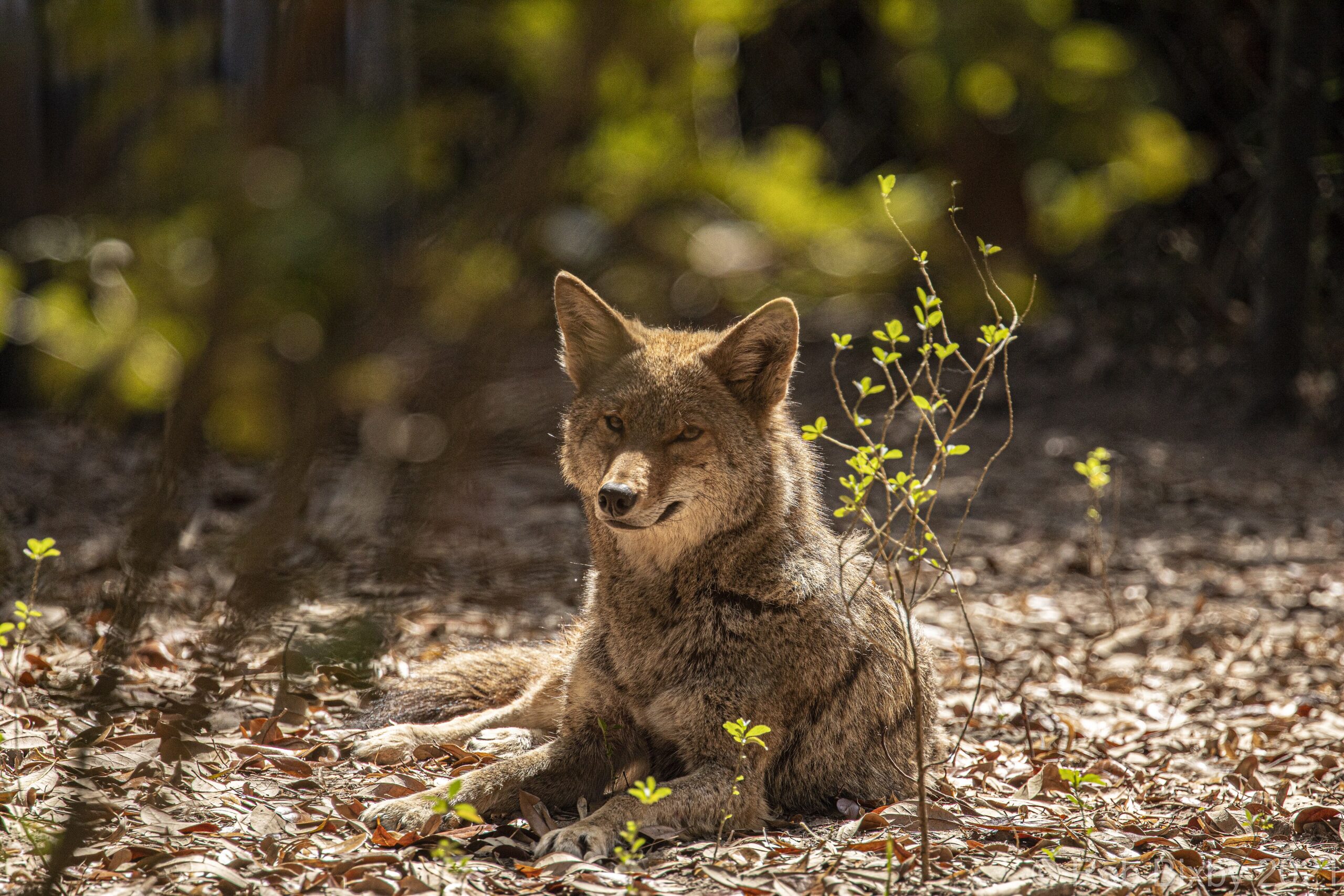
Coyotes Have Come Within 16 Steps of Claudette Rothschild’s Back Door in Altamonte Springs’ Oak Harbour, and One Killed the Feral Cat She Had Cared For Over a Year
It is 16 steps from the tree where coyotes have appeared to Claudette Rothschild’s back door in the Oak Harbour neighborhood of Altamonte Springs, according to a local TV report on the sightings. Coyotes have shown up in her backyard multiple times, and her Ring camera has caught several of the visits. One of them killed a feral cat she had cared for over a year.
Repeat visits caught on a Ring camera in Oak Harbour
Rothschild, who lives with a small dog named Beau and two cats, described the sightings to WKMG News 6 reporter Ashley Garrett in a report published Oct. 13. She said she has seen the animals “only a matter of feet” away.
She described one coyote as “the size of a German Shepherd at least.”
The losses have already started. Coyotes killed the feral cat Rothschild had looked after for more than a year, and a coyote reportedly killed a neighbor’s family dog, according to the station.
Rothschild has posted warnings online, urges neighbors to keep small pets inside, and now carries something noisy or a flashlight when she walks Beau after dark.
Oak Harbour is a residential neighborhood in Seminole County, north of Orlando. The coyotes Rothschild has seen were not in a park or a wooded lot. They were in her own backyard, near a tree a short walk from the house.
Not the first coyote scare in Altamonte Springs
Coyotes have frightened this Seminole County city before. In February 2025, Chris Mack told News 6 that several coyotes came at him from a nearby yard while he walked his 3-year-old service dog in the Country Creek neighborhood along Leatherwood Drive. He said he had to fight them off. His dog ran off during the attack but later came back to him. Mack was taken to a hospital with injuries to his face, arm and hand, and received a rabies vaccination there. The Florida Fish and Wildlife Conservation Commission said at the time it was investigating.
In Oak Harbour, FWC told News 6 it has no reports of coyote attacks or deaths in the neighborhood. The agency’s advice for anyone who meets a coyote is to make noise, wave their arms, and spray the animal with a strong stream from a hose to encourage it to leave.
A relatively recent arrival in Florida yards
A University of Florida wildlife fact sheet on living with coyotes describes the animals as a relatively recent arrival in the state and as omnivores that play a role in local food webs and may help control some pest rodent populations. Problems are rare, the authors write, but coyotes can sometimes become dangerous or cause damage.
Some Florida cities publish their own coyote advice for residents. The City of Delray Beach’s coyote page recommends motion-activated alarms or sprinklers for yards, and coyote rollers, which can keep the animals out of fenced yards.
Yard changes that make a property less inviting
Much of what draws coyotes into a backyard is food that gardeners and pet owners leave out without thinking of it as food. A guide to living with urban coyotes from the Florida Fish and Wildlife Conservation Commission and UF/IFAS asks residents never to feed coyotes and to pick up pet food, fallen fruit and the birdseed that spills under feeders.
The same guide recommends keeping garbage cans and compost in animal-proof containers, and closing off crawl spaces under porches and sheds, where coyotes may rest or raise young. It puts adult Florida coyotes at 15 to 30 pounds, with litters of 2 to 12 pups a year.
Delray Beach lists the same attractants, pet food, garbage, birdseed and fallen fruit, and asks residents to secure them. For backyard chickens and other livestock, the city says enclosures should have four walls and a roof.
For gardeners, that list maps onto ordinary fall chores: raking up dropped fruit under backyard trees, keeping compost bins closed, and sweeping seed from under bird feeders.
Protecting Beau and other small pets
For pet owners like Rothschild, the state guidance is direct, and much of it matches what she has already started doing. The FWC and UF/IFAS guide says pets should not roam freely, dogs should be kept on a short leash and cats should stay indoors, with extra care at night, dusk and dawn and in wooded or heavily planted areas.
Delray Beach goes further on pets, advising owners to keep them indoors or stay with them outside, even in a fenced yard, and to use 6-foot leashes on walks. To scare off a coyote, the city suggests sudden loud noises and threatening gestures: yelling, air horns, banging pots and pans, or shaking a can filled with nuts, stones or coins. A squirt from a hose also works. That matches the advice FWC gave News 6 for Oak Harbour.
The FWC and UF/IFAS guide also covers children. It says children should be told not to approach unfamiliar animals and taught to move calmly indoors, or up onto a swing, tree or deck, if a coyote approaches.
For problems, the FWC and UF/IFAS guide lists the agency’s Wildlife Alert line, 888-404-3922. Delray Beach notes that FWC regional offices can connect residents with a wildlife assistance biologist on weekdays from 8 a.m. to 5 p.m.
Backyard coyote encounters have turned up in other states this fall too, from Dan Millea’s dog Luna disappearing from his South Charlotte yard to a toddler hurt in his family’s Atwater Village backyard after months of neighbor warnings.
In Oak Harbour, Rothschild’s routine has already changed: small pets kept inside, a flashlight or noisemaker in hand for night walks with Beau, and warnings posted for the neighbors.
Get stories like this by email. Sign up for The Parent Diaries Letter.
This article was produced with AI assistance and edited for accuracy against the sources linked above.
Image: Rob Bixby from Jacksonville, FL, USA – CC BY 2.0/Wikimedia Commons