More Than 200 American Beech Trees in New Jersey’s Old-Growth Saddler’s Woods Are Now Infected With Beech Leaf Disease
A roundworm too small to see without a microscope has now reached more than 200 American beech trees in Saddler’s Woods, the old-growth preserve in Haddon Township, New Jersey. The Saddler’s Woods Conservation Association counted the infected trees as beech leaf disease spread through the 25-acre forest, The Philadelphia Inquirer reported on Oct. 12. American beech makes up most of the old-growth trees that form the densest part of the preserve’s canopy.
Janet Goehner-Jacobs, the association’s executive director, told the paper that no effective treatment exists, and she said the all-volunteer conservation team is “actively working every angle” available to it.
More than 200 infected trees in a 25-acre preserve
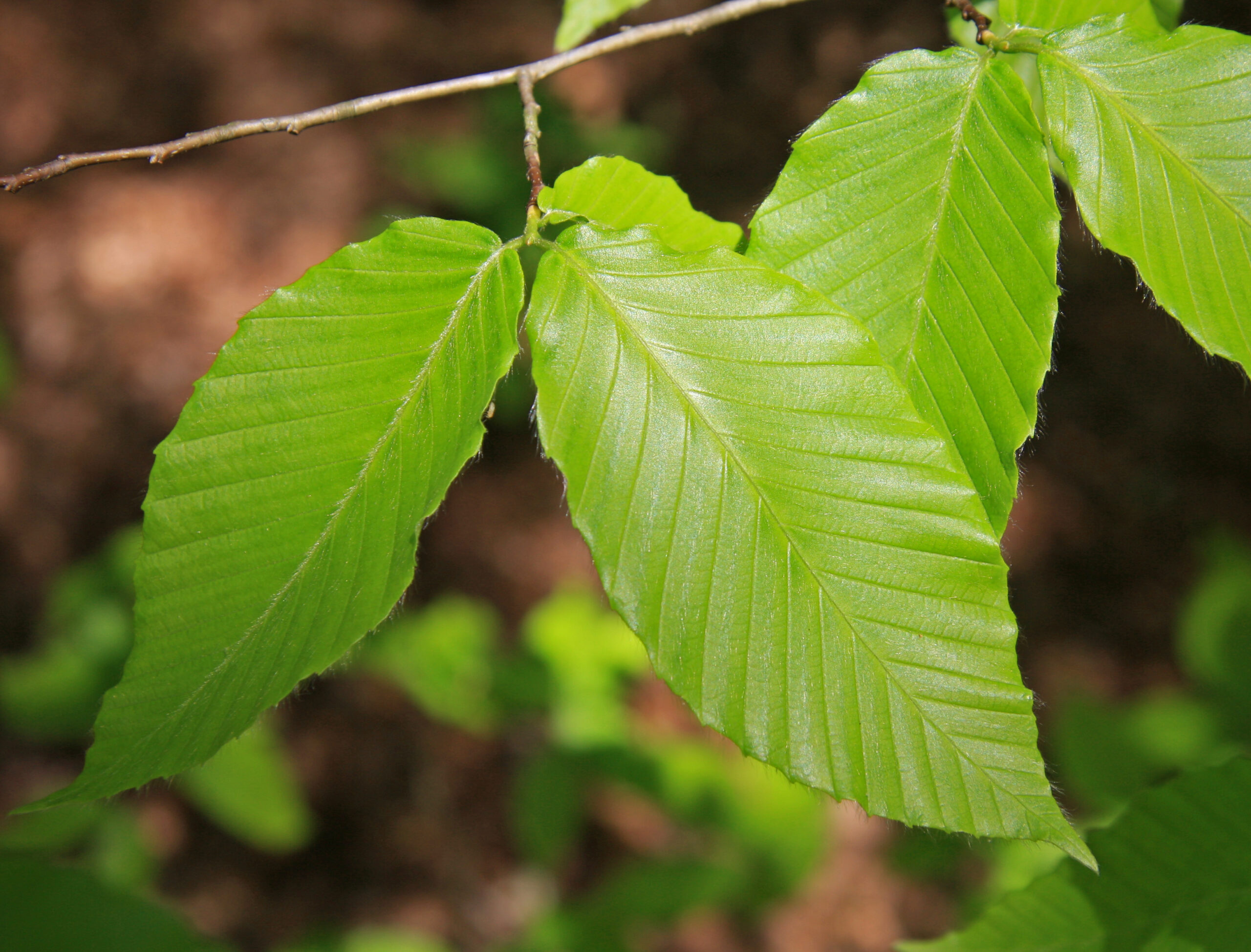
Saddler’s Woods sits along MacArthur Boulevard in Camden County. The disease shows up in the leaves first: dark bands between the veins, followed by smaller, curled and discolored leaves. Trees typically die four to five years after the first infestation, the Inquirer reported.
The losses reach beyond the beeches themselves. Beechnuts are a critical food source for many animals, and hollows in the old trees serve as nursery nests for horned owls, the Inquirer reported. As the beech canopy thins, more light and growing space open up on the forest floor, which can give invasive plants room to spread. The paper reported that losing the beeches could shift the forest’s natural succession timeline by “hundreds of years.”
The conservation team is identifying a small number of mature beech trees that might benefit from an “expensive and experimental” fungicide that has been shown to boost some trees’ defenses.
A worm that lives inside the leaves
Beech leaf disease is caused by an invasive nematode, Litylenchus crenatae subsp. mccannii, that feeds inside leaves and leaf buds rather than in the roots. It is believed not to be native to North America, and its origin is still being studied, according to a Rutgers Cooperative Extension fact sheet written by agents and researchers including Richard Buckley, director of the Rutgers Plant Diagnostic Lab and Nematode Detection Service.
Symptoms were first observed in northeast Ohio in 2012, according to a U.S. Forest Service pest alert. The disease has since been found in several other states and in Ontario, Canada. American beech is the main host, but the Forest Service says symptoms have also appeared on European, Oriental and Chinese beech, which are sometimes planted as ornamentals.
The Rutgers fact sheet says the nematodes spread in several ways. Wind, humidity and rain can carry them at least 38 feet from an infected tree. The native beech blight aphid, tussock moth caterpillar droppings and spider webs may move them, and birds that eat beech buds can carry nematode DNA in their feathers. People moving nursery stock that shows no symptoms are also suspected of spreading the disease. The most active spread happens from midsummer to early fall.
Once symptoms start, decline can be quick. The Forest Service says trees can die within 2 to 7 years of symptoms appearing, most often smaller trees under about 5 inches in diameter. Rutgers puts mortality at 1 to 2 years for small saplings and 6 to 10 years for large mature trees.
Every county in New Jersey
The disease has moved fast in New Jersey. A Rutgers Plant and Pest Advisory report by Buckley says it was first reported in the state in 2020, and by late 2021 it had been confirmed in 10 counties: Bergen, Essex, Hunterdon, Mercer, Monmouth, Morris, Passaic, Somerset, Sussex and Union.
It is now in all 21. Raeanne F. Raccagno, a spokesperson for the New Jersey Department of Environmental Protection, told the Inquirer the spread affects “all 21 counties,” and the state considers the disease widespread. New Jersey has about 14 million American beech trees, and several million are likely affected, along with nonnative European and Oriental beech. According to the state forest service, it is now harder to find a beech without symptoms than one with them, the Inquirer reported.
Treatments that remain experimental
Rutgers describes every current treatment as experimental, with limited data on how well each works. The options it lists include:
- Phosphite soil drenches (Polyphosphite-30), which improved the health of small saplings 2 to 4 inches in diameter over five years in trials.
- Fluopyram (sold as Broadform), which reduced nematode numbers and improved canopy density in trials. It is applied four times at 21-day intervals starting in late July.
- Thiabendazole (Arbotect 20-S), injected into the trunk, usually in June, once every other year, for trees over 10 inches in diameter with less than 50% dieback. Rutgers says trials rated it the most effective option so far.
- Chitosan, still under trial with no published results.
The fact sheet stresses that product labels must be followed. It also says pruning and raking leaves have not been shown to prevent the disease. There are no quarantines on beech nursery stock or debris, but the authors advise against moving either.
For homeowners with beech trees, Rutgers recommends weighing treatment while understanding that the products are experimental, expecting decline if trees are left untreated, planting native replacement trees such as black gum, protecting new plantings with deer fencing, and controlling invasive plants that move in as the beech canopy thins.
A forest that has been saved before
Saddler’s Woods has survived earlier threats. The conservation association’s history says a high school student’s ecology report in the 1970s persuaded the owner not to build high-rises there, and residents fought off a townhome proposal in 1987 and 1988. More than 1,800 petitions helped lead Haddon Township to adopt a conservation easement on April 22, 2003, that permanently protects its portion of the woods. Experts confirmed in 2002 that some of the trees were more than 150 years old.
The woods are named for Joshua Saddler, who escaped enslavement on a Maryland plantation, settled in New Jersey and, according to the association, left a will that barred his heirs from cutting the timber on his land. The township named the area Saddler’s Woods in January 2004, and the conservation association was founded that June. More than a thousand visitors a year now use the woods for volunteer work, tours and walks.
Get stories like this by email. Sign up for The Parent Diaries Letter.
This article was produced with AI assistance and edited for accuracy against the sources linked above.
Image: Dcrjsr – CC BY 3.0/Wikimedia Commons