His Neighbor’s $3,800 Robot Mower Kept Chewing Up His Pollinator Garden. After It Hit His $95 Edging, the Neighbor Asked Him to Pay for Repairs.
Two neighbors share a straight property line between their front yards. On one side, a homeowner put in a small native pollinator garden. On the other, his neighbor bought a $3,800 robotic mower. Over the next several weeks the mower kept rolling across the line and into the flowers, according to an Oct. 12 report by Cheezburger writer Ally Perry.
The homeowner eventually put down $95 worth of metal edging inside his own yard. About a week later, the neighbor said his mower had hit it and damaged its blades, and asked the homeowner to cover the repair.
A weekend garden and a mower on a boundary wire
According to the report, the neighbor bought the robotic mower the previous spring. It runs inside a boundary wire and can be controlled from a phone app. The article did not name the brand.
Around the same time, the homeowner planted his pollinator garden, a mix of native flowers and grasses. It cost a few hundred dollars and took a weekend to put in.
A few weeks later, the mower crossed the line and damaged some of the plants. The neighbor apologized and said he would adjust the boundary settings. Over the next month the mower crossed again several times, and each time it damaged a larger section of the garden. The homeowner’s doorbell camera recorded multiple crossings.
The $95 edging and the repair estimate
Before doing anything, the homeowner checked property records to confirm where the line was. He then installed the metal landscape edging a few inches inside his own yard, and said there were no HOA rules against it.
About a week later the neighbor came over with a repair estimate. He said the mower had struck the edging and damaged its blades, and asked the homeowner to pay for the repair and for a rental mower in the meantime. His argument was that the homeowner had created a hazard near the boundary and should have warned him first. A third neighbor suggested the two split the cost.
The homeowner laid out two options for readers: pay part of the repair and move the edging back, or refuse, since the mower had been entering his yard long before the edging existed, and keep the camera footage ready if needed. Most commenters chose the second. Several said the mower’s owner was responsible for where it went and should pay for the damaged plants. The article did not report how the dispute ended.
What robot mowers do well, and where they need limits
Robotic mowers have become common enough that extension services are studying them. A March 2026 publication from UF/IFAS Extension, written by Jaspal Singh, P. Agustin Boeri, J. Bryan Unruh and Alex J. Lindsey, notes that their blades are under 1.5 inches long, compared with about 20 inches on a traditional mower, and that the blades should be replaced every six to eight weeks during the growing season. In UF research, St. Augustinegrass mowed by a robot showed more uniform and greener cover than conventionally mowed turf.
The same publication points out that most robotic mowers were designed for cool-season grasses usually cut below 2.5 inches, which can fall short of the 2.5 to 4 inches St. Augustinegrass needs. In other words, the machines work best when the area they mow is set up carefully, boundary included.
The legal side of a machine crossing a property line is not new either. Cornell Law School’s Legal Information Institute explains that trespass to land can include causing an object to enter someone else’s property, and that the owner does not have to prove a drop in property value to have a claim.
Why a small native garden is worth protecting
For the homeowner, the damage was more than a few plants. Jennifer Hopwood, a senior pollinator conservation specialist at the Xerces Society, has written for Bee City USA that native plants are the best at supporting insect diversity and abundance, and that even a small patch of native wildflowers makes a difference. She also notes that many bees nest in the stems of perennials.
The Xerces Society’s guide to protecting pollinators at home says most native bees forage only within a few hundred yards, which is why a single front-yard planting can matter to the bees around it. The guide also suggests mowing lawns less intensively and only one section at a time.
Gardeners who share a line with a robotic mower can protect a planting the way this homeowner did, with a physical edge and a record of where the boundary sits. What happens when the machine hits that edge, as this case shows, can still become a neighbor dispute of its own. Other gardeners have dealt with worse along the property line, including one who said her neighbor sprayed pesticide right along the fence line next to her pollinator garden.
This article was produced with AI assistance and edited for accuracy against the sources linked above.
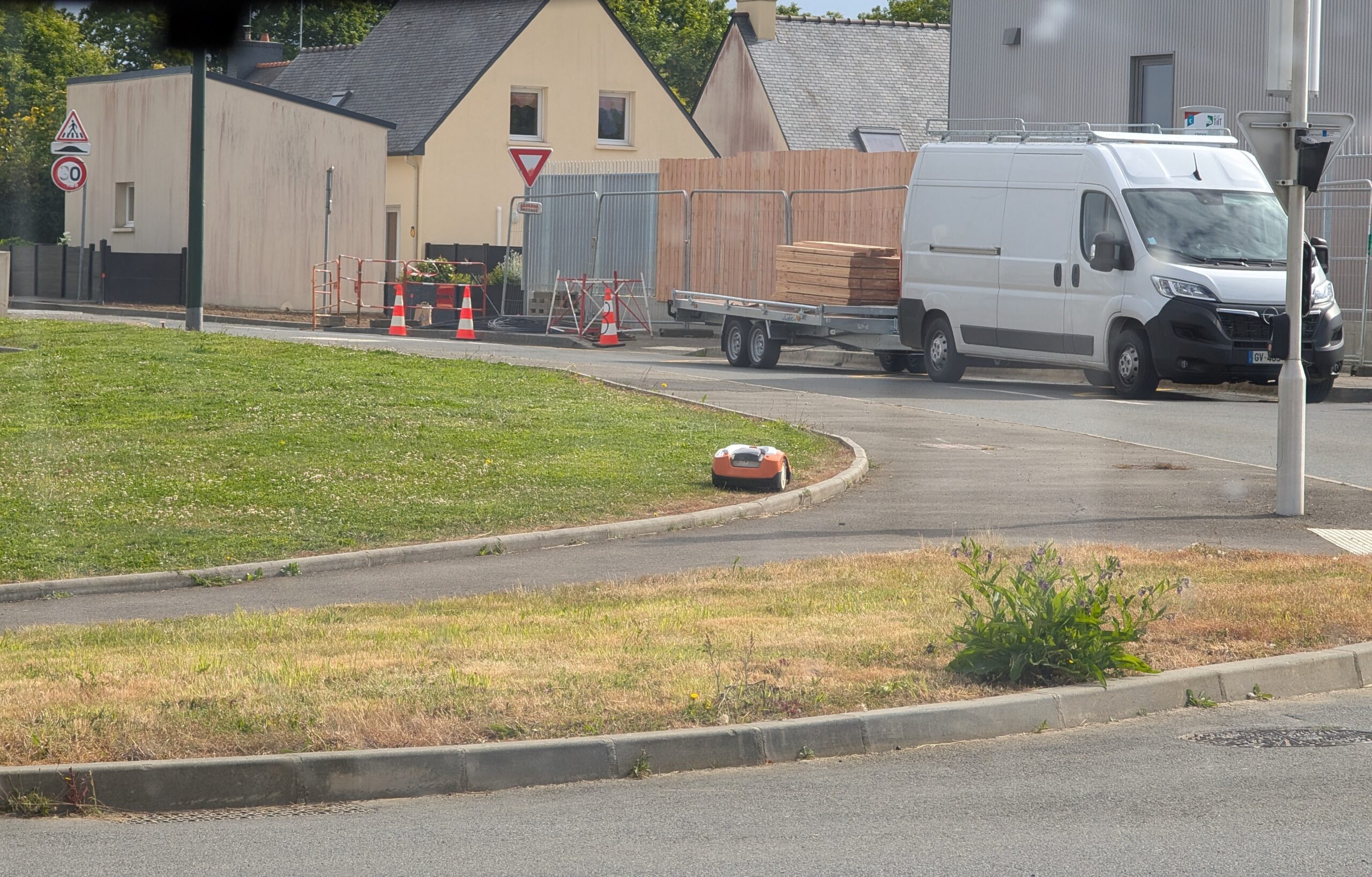
Image: “Robotic lawn mower on roundabout, Lannion” by Syced is marked with CC0 1.0.