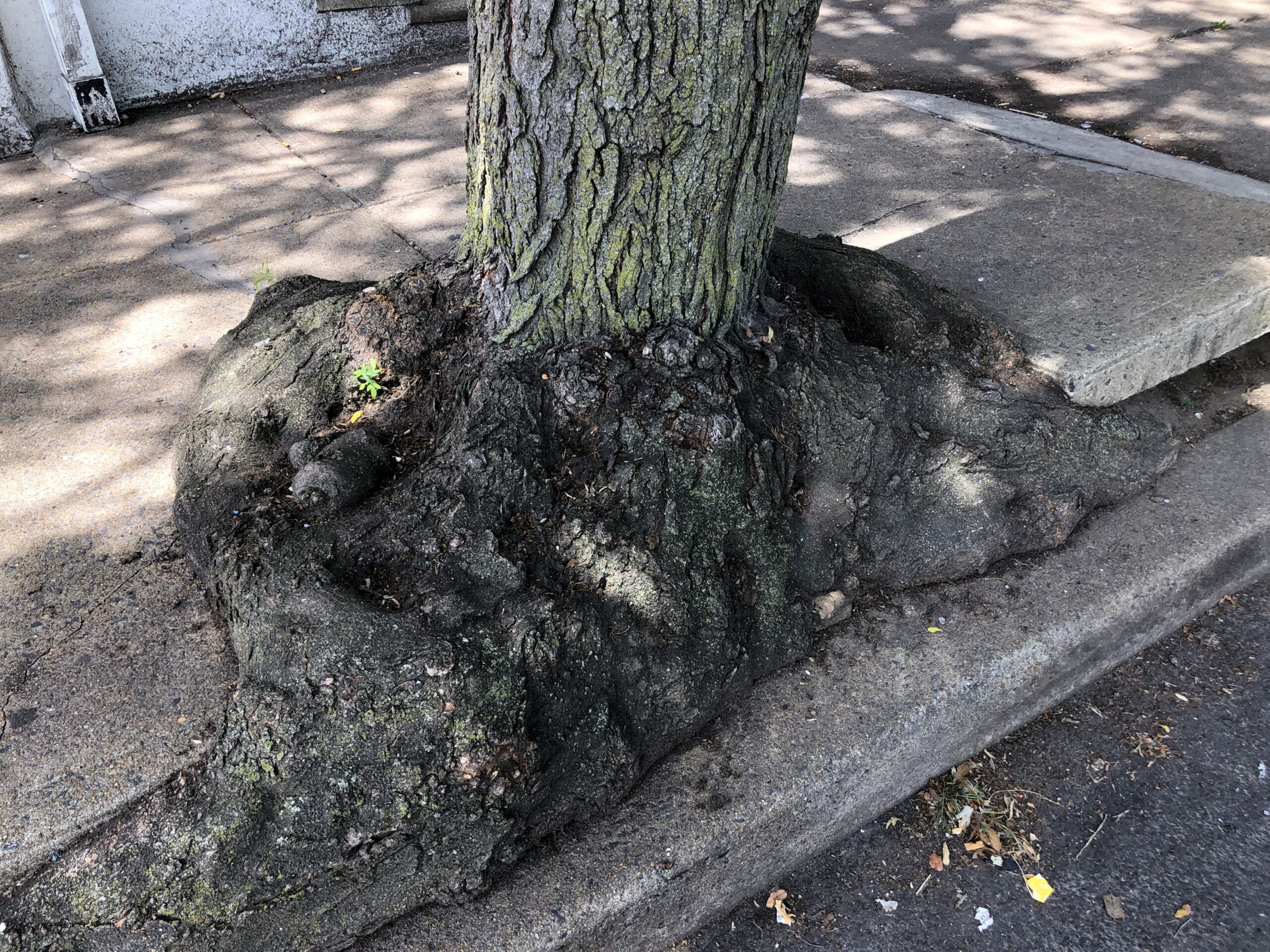
Palo Alto Is Being Sued for Nearly $324,000 by a Building Owner Who Says a City Street Tree’s Roots Flooded Its Basement
A 1929 Spanish Colonial Revival building on Bryant Street in downtown Palo Alto is at the center of an unusual fight over a single street tree. The building’s owner, KG-Bryant LLC, filed a lawsuit against the City of Palo Alto on Oct. 20, saying the roots of a city-owned tree pushed into the property and flooded its basement.
The company is asking for nearly $324,000, according to Hoodline’s report on the Santa Clara County Superior Court filing. The bulk of that money would pay to tear out the sidewalk, replace the waterproofing on the basement wall and plant a new tree.
A Basement the City Once Rented
The building at 518-526 Bryant Street is no ordinary storefront. City records describe it as a two-story, reinforced-concrete commercial building over a basement, designed by noted Palo Alto architect Birge M. Clark and built in 1929 as the Palo Alto Hardware Co. building. A city historic evaluation found it eligible for the California Register for its architecture and recommended it for the local historic inventory.
There is a twist in who was using the flooded space. KG-Bryant leased the basement at 526 Bryant to the city’s own Planning and Development Services Department until January of this year, according to the complaint as described by Hoodline. The building served as one of three city permitting locations, alongside City Hall and 285 Hamilton Avenue.
The lawsuit says the water problems were first documented in 2024, before the city moved out. In November 2025, Palo Alto Building Manager Kyle Shea reported water leaking into a storage room during rain, the filing states. Flooding followed during the 2025 rainy season.
What the Owner Says the Roots Did
According to the complaint, roots from the street tree grew into, beneath and against the property, reaching the basement’s structural wall and the structure that supports the public sidewalk. The company says the city owns both the parkway strip and the tree, which falls under Palo Alto’s urban forestry program.
KG-Bryant hired the engineering firm Allana Buick & Bers to investigate. A Feb. 5 report from the firm ruled out other possible causes of the water coming in, the filing says. The owner describes the damage as substantial and disproportionate and says the city has not paid just compensation.
The roughly $324,000 claim breaks down into two parts, as reported by Hoodline:
- About $318,000 for remediation, including removing the sidewalk, tearing out damaged waterproofing, installing new waterproofing and planting a replacement tree.
- About $5,700 for the investigation and mitigation work by the engineering firm.
As of Oct. 22, court filings showed no response yet from the city, and it is not clear whether Palo Alto disputes the root-damage findings. The claims in the lawsuit have not been tested in court.
The Fern Pine on the City’s Removal List
The city’s own records show a tree at this address had already been flagged. After the leak reports, the Public Works Department issued a tree removal notice citing root damage to the basement, according to the complaint. Palo Alto’s published public tree removal list includes a 20-inch fern pine at 524 Bryant, dated Dec. 19, 2025, with the reason given as “Damaging private structure.”
That is not a routine reason for the city to take down a public tree. Palo Alto’s tree and stump removal page says public trees are removed “only when necessary as a last resort,” mostly when they are dead, dying, diseased or hazardous. Roughly 1 to 2 percent of public trees come down each year. When a tree is approved for removal, the city marks it with a paint dot, contacts the neighboring owner or tenant and posts a 14-day notice on the trunk. A replacement is planted nearby “when there is an appropriate site,” usually between November and March.
Who Owns the Tree Out Front
The case turns on a question many homeowners never think about until something goes wrong: who is responsible for the tree growing in the strip between the sidewalk and the street.
Street-tree rules vary from city to city, and the question of who pays has surfaced elsewhere this fall, from the 100-foot oak cut down outside a Gretna, Nebraska home to the decaying tree that fell on Gimblin Street in St. Louis.
In Palo Alto, the answer is the city. The Urban Forestry FAQ says a tree is a city tree if it stands on public property or in the street right-of-way, which includes parking strips and sidewalk tree wells. Those trees are maintained by city crews and contractors, and residents and private tree services are not allowed to prune them without a permit.
The same rules limit what a property owner can do about roots. The city’s Tree Technical Manual defines a street tree as a “publicly owned tree, shrub or plant growing within the street right-of-way,” and it restricts trenching and excavation inside a tree’s protection zone without approval. For a city-owned tree behind a sidewalk, severing roots more than an inch thick requires sign-off from the Public Works arborist.
Any claim that a city’s property caused damage runs through state law. California Government Code section 835 makes a public entity liable for injury caused by a dangerous condition of its property only if the owner shows the property was dangerous, that the condition caused the damage, and either that a public employee created the condition or that the entity had notice of it in time to fix it.
That last point may matter here. The complaint says the leak was documented in 2024, reported again by the city’s own building manager in 2025, and tied to the tree by the city’s own removal notice. How a judge weighs that timeline will decide who pays for the new waterproofing, the new sidewalk and the new tree that will one day grow in the old one’s place.
Get stories like this by email. Sign up for The Parent Diaries Letter.
This article was produced with AI assistance and edited for accuracy against the sources linked above.
Image: Famartin – CC BY-SA 4.0/Wikimedia Commons