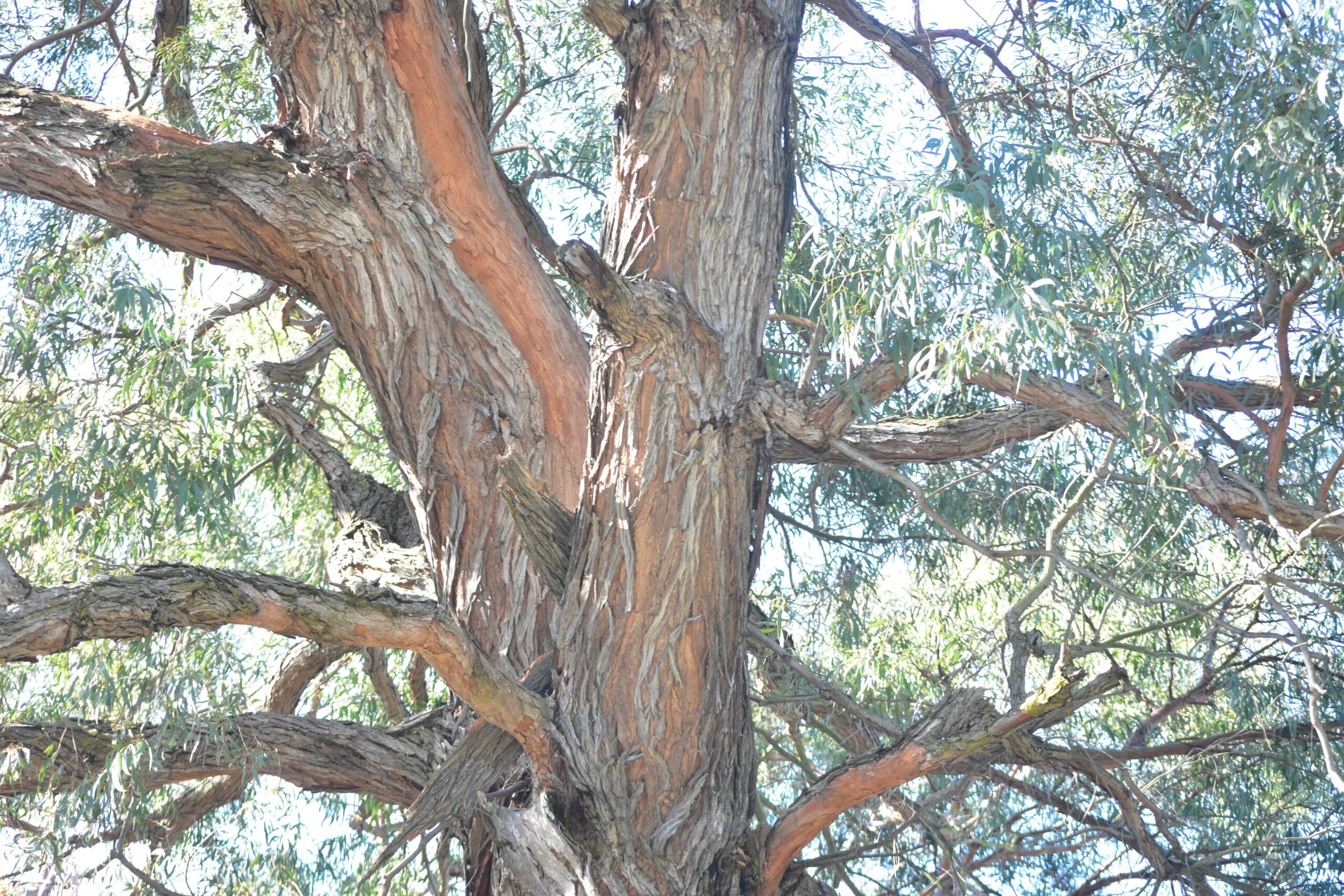
A 20-Foot Piece of Eucalyptus Snapped in High Winds and Pinned a San Jacinto Father of Four in His Backyard, Breaking His Vertebrae and Ribs
Strong winds came up fast on a Saturday afternoon in San Jacinto, California, while Ricky Roldan was out in his backyard picking up his children’s toys. Above him, a piece of eucalyptus at least 20 feet long broke away from the tree and came down across his back. The father of four was pinned to the ground with several broken vertebrae and broken ribs, according to a report produced by KCAL/KCBS and distributed by CNN Newsource.
His family says he is now expected to make a full recovery. The accident, reported Oct. 20, has put a spotlight on one of the most common trees in Southern California yards and on what arborists and university researchers say about large limbs that fail without warning.
Erica Roldan Lifted the Eucalyptus Herself
Roldan’s mother, Alexandra Roldan, said her son heard something just before the limb fell. “He said he heard something when he looked up,” she told reporters.
His wife, Erica Roldan, first tried to lift the heavy piece of tree on her own. When that failed, she ran to neighbors for help and found no one home. She went back to the yard and managed to raise the trunk section just enough for her husband to crawl out from underneath, according to the report. She then called 911.
Paramedics took Roldan to a hospital, where he went into emergency surgery. He has since had several operations and remains in a Moreno Valley hospital with his family around him.
Before one of those surgeries, his mother said, he asked his sister to look after his family because he did not think he would survive. He did. “He’s broken, but he’s going to be great,” Alexandra Roldan said.
Why Big Eucalyptus Limbs Come Down
Eucalyptus trees have a long record of failures in California, and the record is unusually well documented. The California Tree Failure Report Program, a University of California database that collects reports of trees that broke or toppled across California and the western U.S., had logged 268 failures of blue gum eucalyptus, one of the most widely planted species, as of August 2010.
Of those blue gum failures, 44% involved roots, 42% involved branches and 14% involved trunks. The average failed tree was about 62 years old and 81 feet tall. Heavy lateral limbs were the most common structural defect, noted in 28% of reports, and decay was present in 41% of branch failures. Nearly half of the branches broke right at the point where they attached to the tree.
Wind is not the only trigger. The UC Master Gardeners of Butte County describe a separate problem known as summer branch drop, or sudden limb failure, in which long, horizontal limbs snap on hot, calm afternoons with little or no warning. The article, which draws on work by UC Davis landscape horticulture professor Richard Harris, names eucalyptus along with oak, elm and ash as commonly affected. Those limbs typically break 3 to 12 feet out from the trunk, and a tree that has dropped one limb is more likely to drop another.
The cause of the San Jacinto failure has not been publicly identified. Family members described the wind picking up suddenly just before the limb fell.
Warning Signs in a Backyard Tree
The UC Statewide Integrated Pest Management Program lists signs that a tree may be hazardous: mushrooms, conks or other decay fungi on the bark or at the base; cankers and wounds; cavities; cracks in the trunk or where limbs fork; dead or dying limbs; fissures in the soil near the base; and a trunk that leans or tilts. Some problems, such as internal decay or damaged roots, cannot be seen from the outside.
The International Society of Arboriculture adds peeling bark, loose hanging branches, soil that is cracking or lifting under a leaning tree, past topping or heavy pruning, and recent construction or grade changes near the roots. Weak, poorly attached stems are another red flag.
For limb drop in particular, the UC Master Gardeners suggest shortening and lightening long horizontal limbs, thinning the canopy back to healthy side branches, and removing weak limbs that show decay. They also advise keeping play structures, benches, picnic tables and parked cars out from under older trees prone to the problem. The article says the problem cannot always be prevented.
When a Yard Tree Needs a Professional Look
Both UC IPM and the International Society of Arboriculture say any tree that could hurt someone or damage property if it failed should be inspected regularly by a qualified expert. The ISA recommends an ISA Certified Arborist, who must pass an exam and keep up continuing education, and offers “Find an Arborist” and “Verify a Credential” tools on TreesAreGood.org. An arborist can recommend pruning, cabling and bracing, or removal when the risk is too high.
Falling trees have been behind several recent stories on this site, including the decaying tree on St. Louis’s Gimblin Street and the trees that crushed homes during Hurricane Isaias.
Get stories like this by email. Sign up for The Parent Diaries Letter.
This article was produced with AI assistance and edited for accuracy against the sources linked above.
Image: Quixoticelixer- – CC BY 4.0/Wikimedia Commons