Spotted Lanternflies Have Reached Belmont, Massachusetts, Where a Gardener Found Two on the Virginia Creeper in Her Own Back Garden
Belmont gardener Dorothy Gilman did not need a state survey to know the spotted lanternfly had arrived in her town. She found two of the insects on the Virginia creeper in her own back garden and killed them, she wrote in the Belmont Voice on Nov. 2, under a column headed “The Arrival of the Spotted Lanternfly.”
The sap-feeding pest, first found in the United States in Pennsylvania in 2014, “has landed in Belmont,” Gilman wrote, adding that it is now definitely established in the area. Her find comes as Massachusetts officials say the insect is now confirmed in more than half the state’s cities and towns.
Two on the Virginia creeper
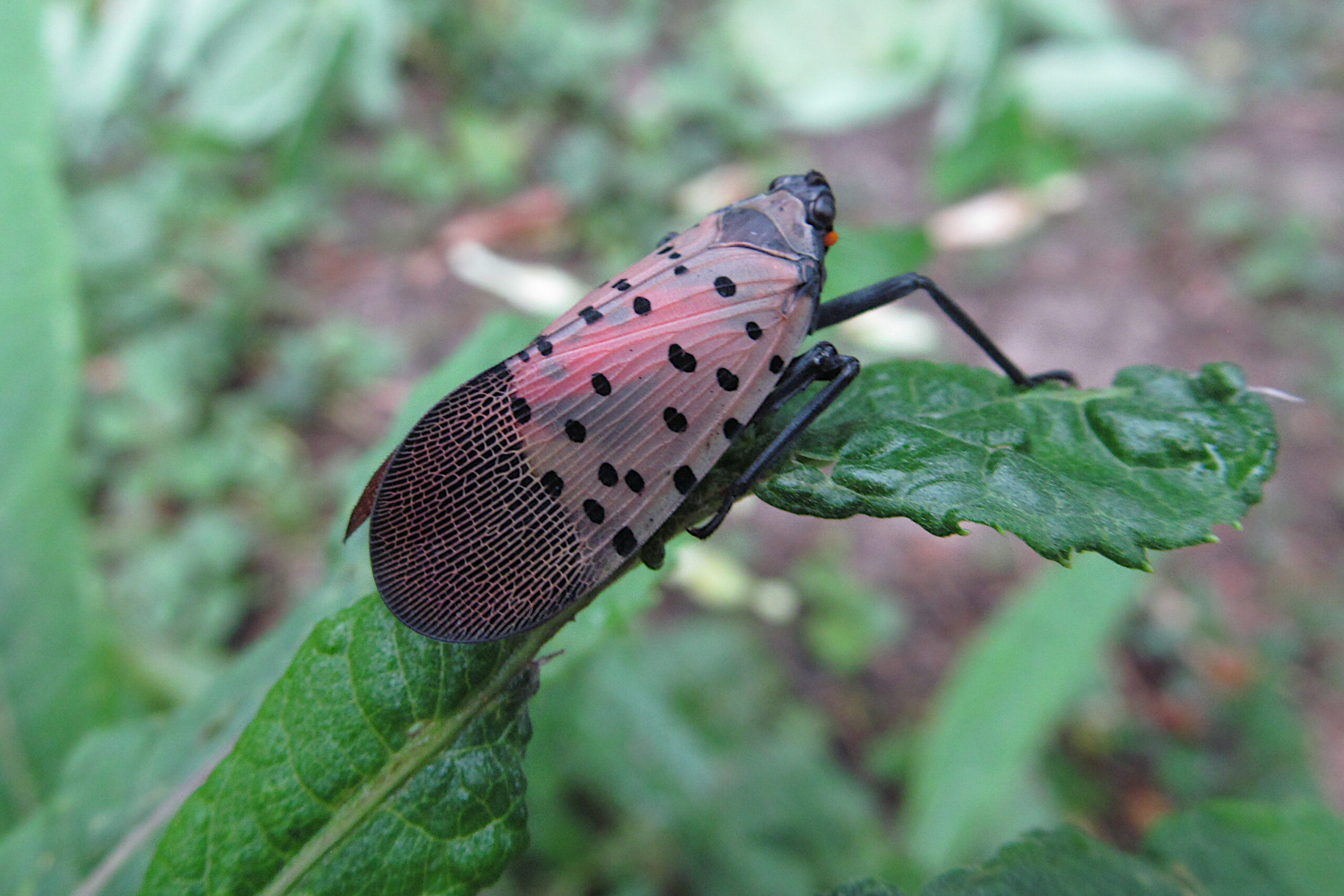
Gilman’s column describes a pest that is easy to miss until it moves. Adults are about an inch long and look gray-pink with black spots when their wings are folded. When the wings open, they show a red body underneath. A flash of red, Gilman notes, means the insect is getting ready to flee.
Younger stages look different. Early nymphs are up to a quarter inch long, black with white spots, and can be mistaken for ticks. Later nymphs grow to about three-quarters of an inch, with a red body, black stripes and white spots.
Virginia creeper is only one of the plants it uses. Gilman lists grapevines, maple, birch, willow, walnut, hops and fruit trees, especially stone fruits, among more than 100 host plants. Its favorite is tree of heaven, an invasive, weedy tree. The Massachusetts Department of Agricultural Resources also names tree of heaven as the primary host and warns that the insect targets grapevines, hops and fruit trees, which is why it could become a serious agricultural pest.
The damage in a home garden comes from what the insects leave behind. Their sticky honeydew grows sooty mold, which in heavy infestations can block photosynthesis on the leaves below.
More than half of Massachusetts communities
Belmont is joining a long list. At a Nov. 4 meeting, MDAR announced 186 known infestations, including 78 communities confirmed this year, according to the Greenfield Recorder’s Nov. 9 report by Emilee Klein. That puts the pest in more than half of the state’s cities and towns.
The climb has been steep. MDAR’s count of new infestations went from 4 in 2021 to 12 in 2022, 43 in 2023 and 65 the year after. The first Massachusetts reports came in late 2020. “At this point, it’s here,” MDAR survey technician Astra Perkins said.
Officials on the North Shore have been tracking the same spread. Peabody Weekly News reported in October that sightings had been reported in nearly 150 Massachusetts municipalities and in every county except Nantucket, citing MDAR environmental biologist Jennifer Forman Orth. The first breeding population in the state was found in Fitchburg in 2021.
In western Massachusetts, the Recorder counted 10 Hampshire County communities, 15 Hampden County areas and two Franklin County municipalities with confirmed infestations, with the largest Pioneer Valley populations in Springfield and Holyoke. When the insect reached Greenfield in October, the Recorder noted that MDAR does not believe it can be eradicated, and that the insects do not bite or sting but can swarm and leave sticky honeydew that is hard to wash off.
Elsewhere in the state, Greenfield asked residents to check trees, grapevines and car wheel wells after the insect reached that city, and in neighboring Vermont has asked residents to search patio furniture and firewood for egg masses.
Why the egg masses matter now
The adults Gilman found will not last. They die with the first hard frost. The eggs are a different story. MDAR forest pest outreach coordinator Elizabeth Barnes told the Recorder that Massachusetts winters historically are “nowhere near cold enough to kill them.”
That makes late fall and winter the time to look. Egg masses are grayish blobs that can look like mud, putty or lichen. The Recorder reported that they are about the size of two stacked quarters and lie in straight lines rather than overlapping the way lichen does. Each adult can lay one or two masses of 30 to 50 eggs, according to Forman Orth.
MDAR invasive pest inspector Monica Coskie put the math simply: crushing a single egg mass can take out “potentially 50 lanternflies.”
What Belmont gardeners can do
MDAR does not respond to residential properties, the Recorder reported, so homeowners either remove egg masses themselves or hire a pest control professional. The state scraped 38,000 egg masses from 250 commercial and industrial sites last year.
Gilman’s column lays out the home version. She suggests checking tree trunks, the undersides of branches, outdoor furniture, vehicles, tires, stone and firewood, then scraping masses into sealed bags or containers of alcohol or hand sanitizer, or crushing them with a trowel. Perkins told the Recorder that power washing can also kill the eggs.
For live insects next season, Gilman recommends stomping or squashing them, checking the garden at dusk when they gather on trunks and stems, and holding a pail of soapy water underneath before reaching for one. For larger numbers, she suggests a vacuum, waiting a day or two before emptying it.
She also suggests talking to an experienced arborist before taking out tree of heaven, because cutting it down makes it resprout from the roots.
Sightings can be reported through MDAR’s online spotted lanternfly report form. For Belmont gardeners, Gilman’s two insects on the Virginia creeper are a reason to check fences, furniture and tree trunks for egg masses this winter.
This article was produced with AI assistance and edited for accuracy against the sources linked above.
Image: Cbaile19 – CC0/Wikimedia Commons