A Tree of Heaven in The Dalles Sent Roots Under the Street and Into a Neighbor’s Crawl Space. This Fall, Neighbors Took Down a Fence to Reach the Last Stand.
“It’s bad. It’s everywhere.” That was how Garry Peterson, a longtime resident and master gardener in The Dalles, Oregon, described the Tree of Heaven when he pointed one out in City Park. By then, the tree had already moved into the neighborhood around Dana Greyson’s home: into her yard, into her neighbors’ yards, under the pavement across the street, and into the crawl space of a house.
Greyson laid out the fight in a November 18 feature for Columbia Community Connection, the local news site in The Dalles. It took neighbors two falls, a lot of digging and, this year, the removal of a fence to reach the last stand.
One Tree in the Park, Then Four Yards
Greyson first noticed a mature Tree of Heaven in City Park while setting up for a plant sale, she wrote. Peterson identified it for her. Once she knew what to look for, she found it closer to home.
Young stands were coming up in her own yard, in the yard of the neighbor to the east, in the yard of the neighbor to the south, and in the yard of a neighbor across the street to the east. The tree does not stay put. According to Greyson, it spreads by runners, can reach 80 feet tall, and a mature female tree can produce 300,000 to 350,000 seeds a year.
The worst of it was underground. Roots from a tree worked their way under the pavement across the street and into the crawl space of a neighbor’s home, she reported.
Why the Roots Matter to a House
Greyson’s experience lines up with what extension specialists warn about. Oregon State University Extension’s Solve Pest Problems page on tree-of-heaven says the tree damages building foundations, pavement and sidewalks, and that its extensive, shallow root system sends up suckers far from the trunk. Those shoots can look like seedlings, but they are still attached to the parent tree.
The Columbia Gorge Cooperative Weed Management Area puts numbers on that reach: roots can spread up to 50 feet in every direction, and new shoots can come up as far as 50 feet from the parent tree. The group says one tree can produce more than 300,000 seeds a year, spread by wind and birds, and that the tree gives off chemicals that hold back other plants.
The weed group also notes that the plant is a favored host of the spotted lanternfly and can irritate skin, and it advises eye and hand protection when working with it.
Two Falls of Cutting, Spraying and Digging
Last fall, Greyson and her neighbors went after the trees. They cut them, sprayed them with an herbicide and dug them up, she wrote.
It was not enough to finish the job. Some holdouts were blocked behind a fence. This fall, to reach that last remaining stand, the neighbors took the fence down. Then they cut, sprayed and dug again, hoping it would be the last of it. Greyson wrote that they will keep watching the spot and act as needed, and that mature trees may call for professional help.
Cutting alone would not have worked. OSU Extension warns that “cutting down a tree without killing it first (with herbicides) will lead to new suckering stems,” and that root pieces left in the soil will regrow. The Columbia Gorge group calls cutting or mowing ineffective on its own and says cut stumps encourage suckering.
What the Experts Say Works
Timing matters. OSU Extension recommends treating from mid-summer to early fall, when herbicide is more likely to reach the roots instead of only injuring the top growth. The Columbia Gorge weed group says treatments should start no earlier than July 1 and continue until fall color appears.
For small stems under 6 inches across, both groups describe a basal bark treatment sprayed on the lower 12 to 18 inches of the trunk. For bigger trunks, they describe the frill method, cuts made around the trunk with herbicide applied to them. Seedlings can be hand-pulled in moist soil, the Columbia Gorge group says. Herbicide labels must be followed, and the group says its guidance is not a formal recommendation.
Follow-up is part of the job. OSU Extension tells homeowners to expect to re-treat for two or more years and to plan for two to three years of monitoring. The Columbia Gorge group says cut material should be chipped, burned where allowed or sent to a landfill, never composted, because stems can root.
For detailed herbicide guidance, Greyson’s article and the Columbia Gorge group both point to the Pacific Northwest Weed Management Handbook, published by Oregon State University, Washington State University and the University of Idaho. Residents of The Dalles can also call the Wasco County Master Gardeners hotline at 541-296-1217 for help identifying a plant.
A Neighborhood Watching for Sprouts
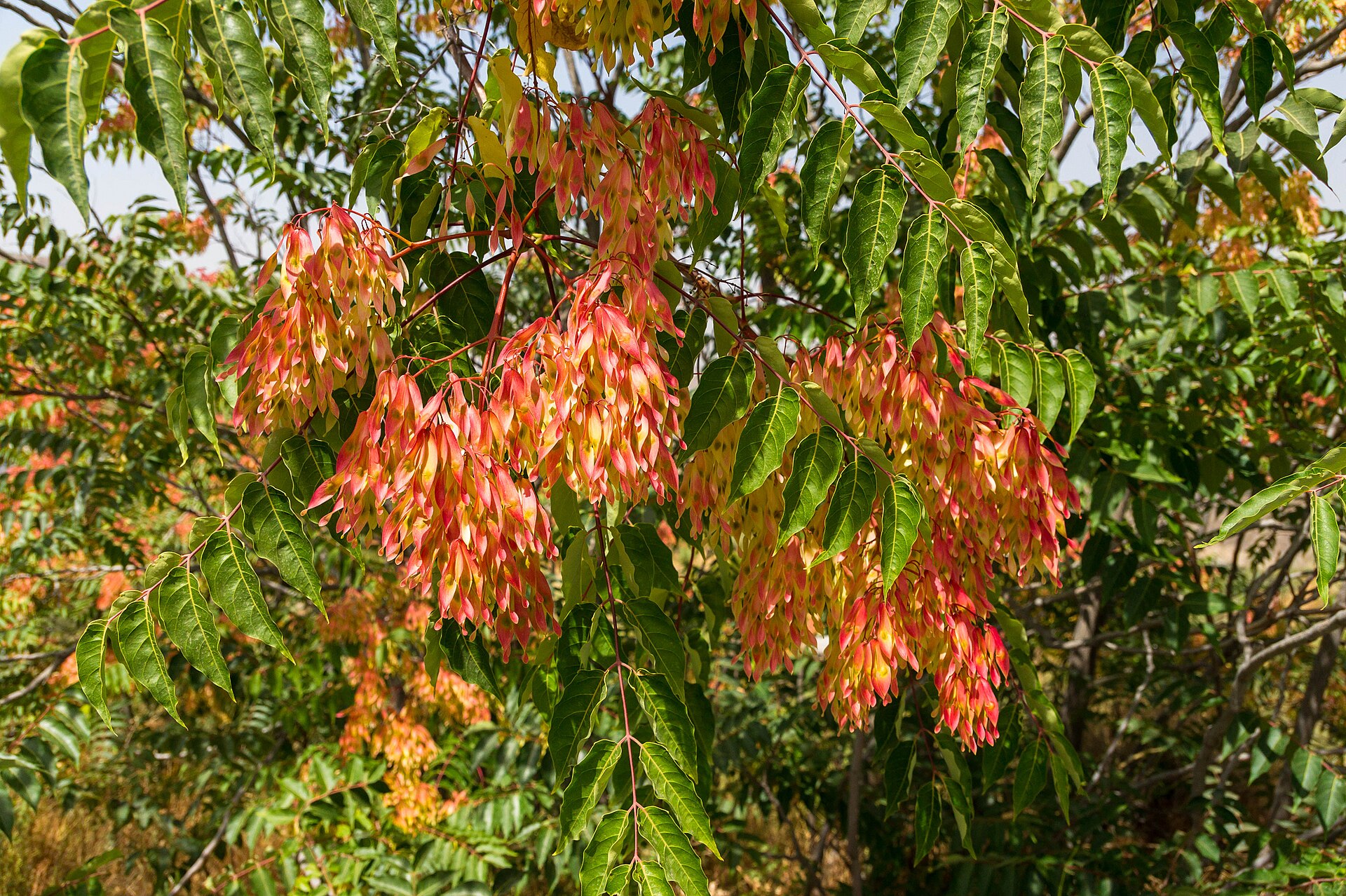
The Tree of Heaven can be confused with black walnut or sumac. OSU Extension says each leaflet has a notched base, while black walnut leaflets are rounded at the base and smell like walnut when crushed. A single leaf can be 1 to 3 feet long.
Trees that cross property lines have caused trouble on this site before, including a homeowner who planned to clear a yard full of trees of heaven before realizing one might sit across the line. In The Dalles, the neighbors chose to work together, fence and all. As Greyson put it, “Tree of Heaven isn’t invincible.”
This article was produced with AI assistance and edited for accuracy against the sources linked above.
Image: Jebulon – CC0/Wikimedia Commons