Emerald Ash Borer Is Now Inside Ash Trees at a College Place Home, the First Confirmed Infestation in Washington State
The U.S. Department of Agriculture has confirmed emerald ash borer in multiple ash trees in College Place, just southwest of Walla Walla, marking the first time the invasive beetle has been found infesting trees anywhere in Washington. State agencies are now asking homeowners to stop planting ash and check the trees they already have.
The federal identification came on Wednesday, Oct. 14, after state officials sent samples from the site, the Washington State Standard reported. Investigators found larvae and the beetle’s telltale D-shaped exit holes.
A Declining Backyard Ash Led to the Find
The infestation turned up during a tree assessment at a private home. Arborist Isaac Long of Mountain View Tree Service visited a Walla Walla County home in late September to look at a green ash in the backyard that had lost much of its foliage, according to Northwest Public Broadcasting, reporting for OPB. He expected the tree would have to come down. Then he spotted tiny D-shaped holes in the canopy.
Long took a small branch to the Washington State University Extension office in Walla Walla. An entomologist with the Washington State Department of Agriculture followed up, and WSDA staff visited the property, where they found pale larvae in multiple trees. Specimens went to the USDA, which confirmed the species.
It is Washington’s second detection of the beetle. The first came in August, when a single emerald ash borer was found on a car windshield in Vancouver. As of Oct. 16, no additional detections had been confirmed beyond College Place, said Will Rubin, communications manager at the state Department of Natural Resources, and arborists in Walla Walla and College Place were surveying public and private land.
What the Beetle Does to an Ash Tree
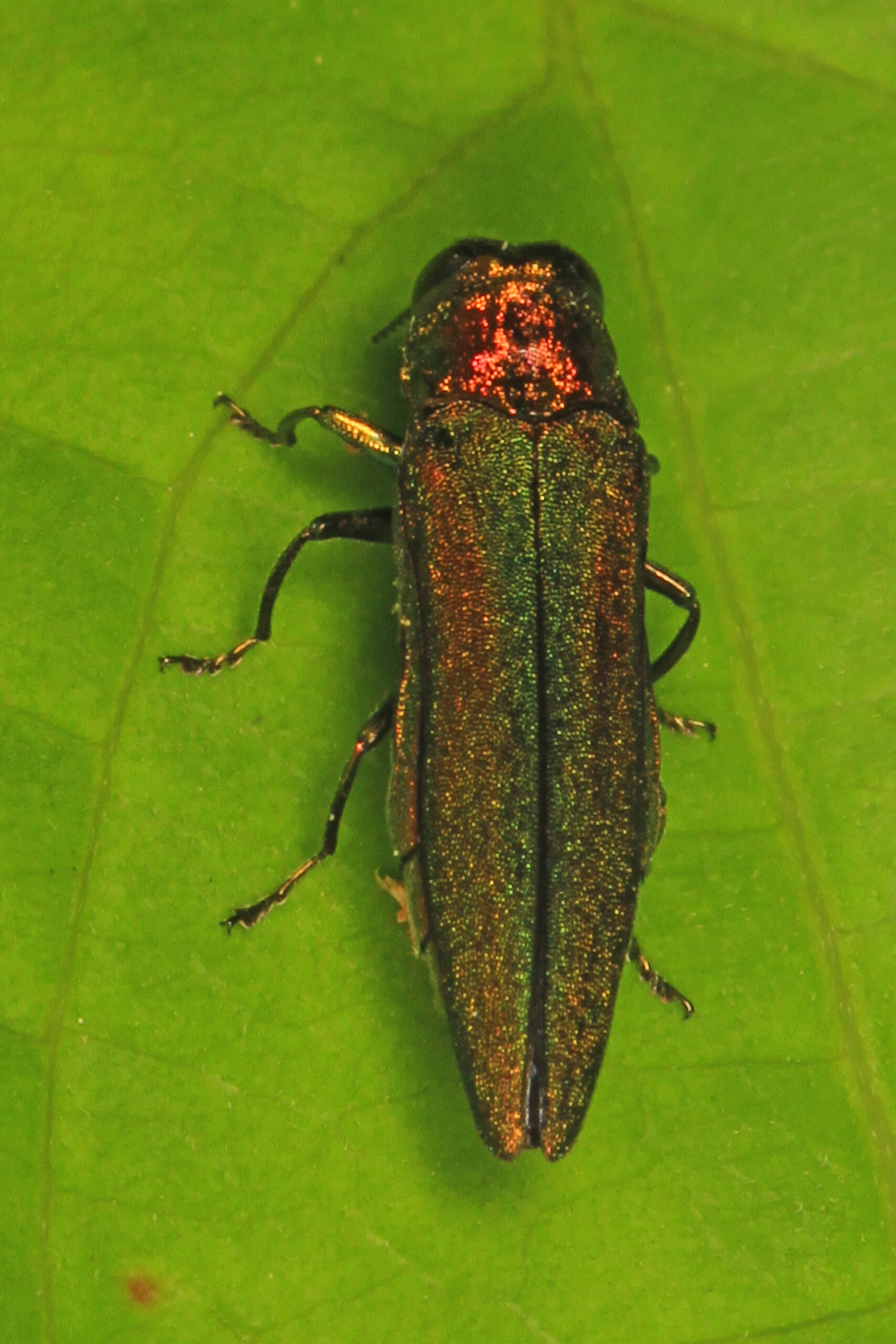
The Washington Invasive Species Council describes the adult as an elongated, jewel-like metallic green beetle about half an inch long. The damage comes from the larvae, which tunnel under the bark and feed on the sapwood, cutting off the flow of water and nutrients. Leaves and branches die back gradually. Heavy woodpecker activity on an ash can be a sign of infestation, because woodpeckers feed on the larvae, and adults leave a D-shaped hole, flat on one side and rounded on the other, when they emerge in spring.
The beetle has killed more than 100 million ash trees in the United States since it was first detected about 20 years ago, and it has never been successfully eradicated, according to the Washington State Standard. All true ash species are vulnerable. A DNR analysis estimates that without management, 90% to 100% of ash trees could be lost within 10 to 12 years of an initial infestation.
Zeima Kassahun, an urban and community forestry specialist with DNR, told OPB that large-scale ash mortality usually follows once the beetle is detected, comparing the threat to the near-loss of the American chestnut. Walla Walla alone has more than a thousand ash trees in its public inventory, not counting trees on private land, said Wes Walker, the city’s parks maintenance supervisor.
What Changes for Homeowners With Ash Trees
WSDA is urging residents to stop planting ash trees. Washington State University Extension’s guide Managing Emerald Ash Borer in Washington State recommends that owners of high-value ash trees begin treatment once the beetle is detected within 30 miles, repeating every two to three years.
The guide names emamectin benzoate stem injection as the recommended option, saying it can protect a tree for up to three years. It must be applied by a licensed applicator in mid to late spring, after trees leaf out and before the beetle lays eggs. Foliar sprays are not effective, and homeowner soil-drench products are less effective, according to WSU. The guide also notes that cutting down healthy ash ahead of time does not slow the spread, and that injection can cost less than removal.
Trees that are already infested should be removed and destroyed, WSU advises, and local authorities can explain disposal options. Mountain ash is not a true ash and is not affected. OPB noted that dead ash grows brittle over time, which makes removal more dangerous the longer it waits.
Landowners can also ask DNR’s Urban and Community Forestry Program for help saving some ash trees or buying time to replace them, as long as funding is available.
Firewood Rules and Where to Report
The beetle usually travels with people, through moved wood products, OPB reported. Washington’s new firewood exterior quarantine, adopted by WSDA in February and in effect since Aug. 18, 2026, bars untreated firewood from entering the state from anywhere outside Washington. Out-of-state firewood must be heat-treated to a core temperature of 160 degrees Fahrenheit for at least 60 minutes and labeled “Approved Pest Free,” or be USDA-certified packaged firewood. Violations carry civil penalties of up to $5,000 each. WSU’s advice for wood moved within the state is simpler: never move firewood, and buy it where it will be burned.
Suspected sightings can be reported to the Washington Invasive Species Council at invasivespecies.wa.gov, by email at [email protected], or through the WA Invasives app. Specimens should be sealed in a plastic bag and frozen, according to OPB.
Get stories like this by email. Sign up for The Parent Diaries Letter.
This article was produced with AI assistance and edited for accuracy against the sources linked above.
Image: Judy Gallagher – CC BY 2.0/Wikimedia Commons