Eggs of the Flighted Spongy Moth, a Tree-Stripping Pest Whose Females Can Fly, Were Found for the First Time in the Great Lakes Region on a Ship at the Port of Detroit
The find was two small, fuzzy patches on the steel of a cargo ship. During a vessel inspection at the Port of Detroit on Sept. 16, 2026, U.S. Customs and Border Protection agriculture specialists spotted two egg masses of the flighted spongy moth, a group of Asian moths whose caterpillars can strip the leaves off trees, Nature World News reported, citing CBP and an earlier CBC News report.
The ship was carrying steel and had arrived from South Korea by way of Hamilton, Ontario. The U.S. Department of Agriculture confirmed the eggs came from two distinct Asian subspecies. According to the Great Lakes Commission, it is the first time the eggs have been detected in the Great Lakes region.
Why a Moth That Flies Worries Tree Experts
Michigan already lives with the European spongy moth, the pest once called the gypsy moth. Its females cannot fly, which slows how fast it spreads from yard to yard and woodlot to woodlot.
The flighted strains are different. The USDA’s Animal and Plant Health Inspection Service says females in the flighted spongy moth complex can fly and spread quickly if they are not controlled, and that the group has a much broader range of host plants than the moth already found in North America. APHIS warns that heavy infestations can strip trees and shrubs of their leaves and can kill forests, orchards and landscapes.
Richard Hamelin, a forestry professor at the University of British Columbia, told CBC News, as cited by Nature World News, that flighted females can travel up to about 25 kilometers, roughly 15 miles. Per Nature World News, the flighted strains also feed on conifers, while the European strain mostly eats broadleaf trees such as oaks.
“Spongy moth is one of those moths whose caterpillars feed on the foliage of a large number of tree species,” Hamelin said.
Up to 1,000 Eggs in a Patch the Size of a Coin
The egg masses are easy to miss. APHIS describes them as covered in buff or yellowish fuzz, about 1.5 inches long and three-quarters of an inch wide on average, and sometimes as small as a dime. On a ship, they can look like rust spots.
Each mass can hold up to 1,000 eggs, and they survive long voyages on hulls, rigging, shipping containers and pallets. Females lay them on smooth, well-lit surfaces, and adults are drawn to outdoor lights at dusk, according to APHIS.
The flighted moths and the familiar spongy moth look almost the same at every life stage. APHIS says a DNA test may be needed to tell them apart, which is how the USDA was able to confirm the Detroit find came from two Asian subspecies.
Ships From Asia Have Been Bringing More of Them
The Detroit discovery follows a heavy year for the pest at sea. A February 2026 joint bulletin from the USDA and the Canadian Food Inspection Agency said heavily infested vessels arrived at North American ports in 2025, some of which were ordered out of port, and warned that populations in the moth’s home range could reach outbreak levels again in 2026.
That bulletin lists South Korea, where the Detroit ship started, as a regulated area from June 1 to Sept. 30. Ships that call there in that window must be inspected and certified free of the moth, and crews are required to scrape off and destroy any egg masses before reaching North America.
Canada has dealt with the moth before. Nature World News noted that after a 2021 detection in the Township of Langley, British Columbia, officials eradicated it in 2022. The reports reviewed show no sign that the Asian strain is established in Michigan, and Hamelin said eggs like these would not hatch until spring.
The Spongy Moth Michigan Yards Already Know
The state’s own invasive species program lists the European spongy moth as established in Michigan. The insect was renamed from the gypsy moth in 2022, and it mostly feeds on oak and aspen, though it also eats the leaves of hundreds of other plants, according to the state.
Metro Detroit homeowners were already being asked this fall to report spongy moth egg masses on their trees before the caterpillars hatch. The moth’s tan, fuzzy egg masses hatch in April, and the caterpillars feed on leaves through late June. Grown caterpillars are hairy, 1.5 to 2 inches long, with a yellow and black head and rows of blue and red spots down the back. Female moths are larger than the males, cream to white with wavy black markings, and they cannot fly.
On the ground, the signs are easy to spot. The state says leaf debris and small, round droppings under a tree are signs of an infestation, and that large outbreaks make yards and outdoor activities messy because of all the debris and droppings.
Michigan’s program says defoliation can leave trees open to disease and other pests, which can eventually kill them. That is part of why a strain that can also eat conifers, and whose females can fly, draws so much attention from inspectors.
How a Pest Hitches a Ride Into a Yard
Even the flightless European moth gets around. Wind can carry young caterpillars from tree to tree, and egg masses and pupae travel on firewood, vehicles and recreational gear, the state says. Hitchhiking egg masses are the same problem behind spotted lanternfly checks on car wheel wells in Massachusetts. Michigan asks anyone who spots the spongy moth to report it through the Midwest Invasive Species Information Network’s online tool or phone app.
For the flighted strains, APHIS asks anyone moving household goods from affected areas overseas to check lawn furniture, outdoor gear, equipment and vehicles for egg masses or caterpillars, and to contact federal or state agriculture officials about any suspected infestation.
The two egg masses in Detroit turned up on a ship’s steel during a routine inspection, not on a backyard oak or pine. The USDA and its Canadian counterpart had warned in February that 2026 could bring outbreak levels in the moth’s home range, and the Detroit interception came in the same year, on a ship that had sailed from one of the countries on that regulated list.
This article was produced with AI assistance and edited for accuracy against the sources linked above.
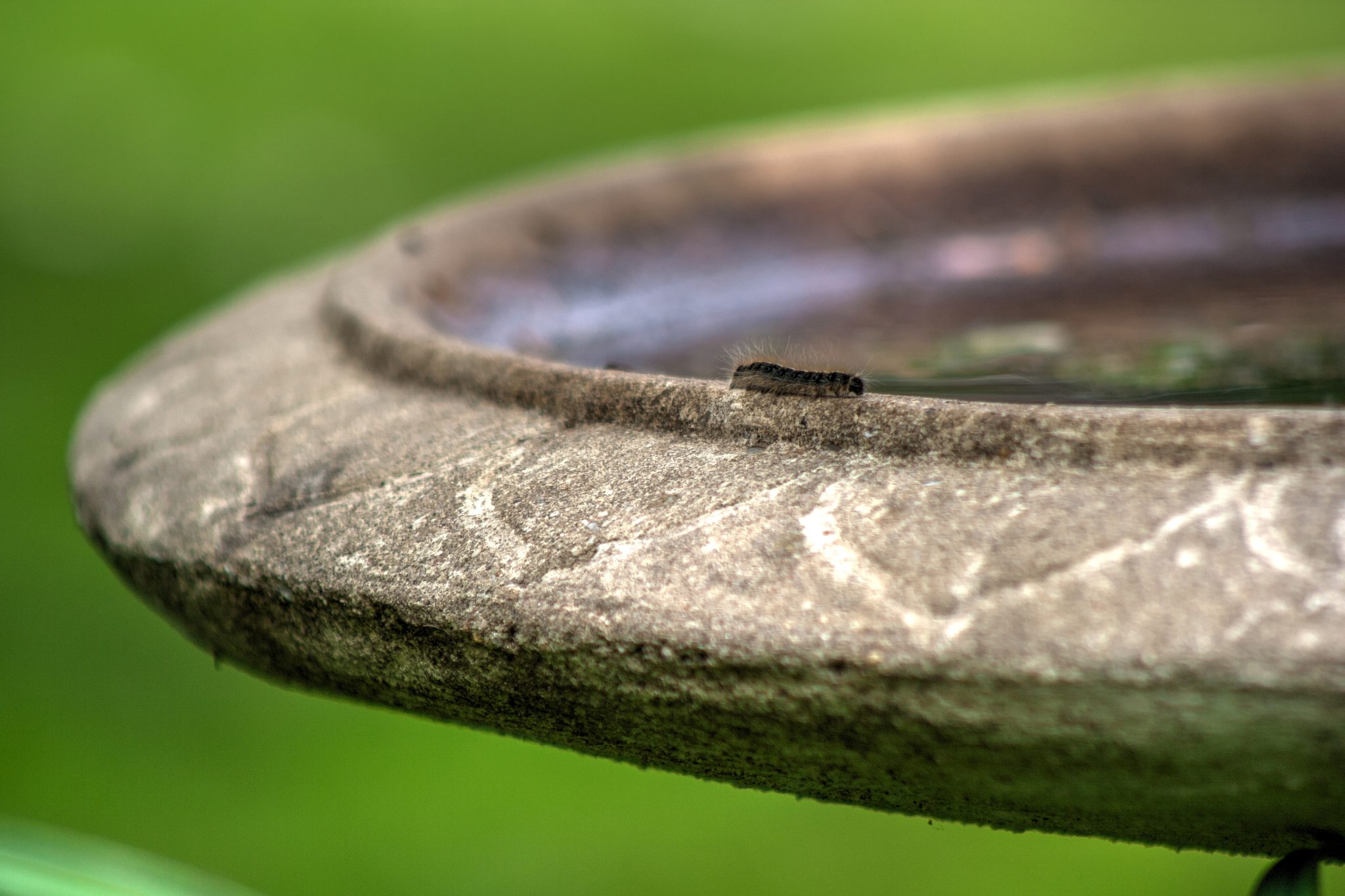
Image: “A small Gypsy Moth Caterpillar walks the perimeter of a bird bath on a warm summer day.” by Jeff Golenski is marked with CC0 1.0.