Border Wall Crews Cut Down Lochiel, Arizona’s Last ‘Grandmother’ Cottonwood After a 71-Day Tree-Sit, and Activists Say at Least 12 People Were Arrested
At about 6:30 a.m. on Monday, Oct. 5, protesters camped beside a cottonwood in Lochiel, Arizona, were gathered for their daily sunrise prayer when Border Patrol agents moved in. By the end of the raid, contractors had cut down the tree activists called the “grandmother,” the last of four cottonwoods marked for removal along the border, and activists said at least 12 people had been arrested.
The felling ended a 71-day tree-sit that began after three other cottonwoods came down in June to make way for a double border wall.
A Sunrise Prayer Interrupted on Border Road
The tree stood on Border Road, a dirt road that runs along the U.S.-Mexico line in the San Rafael Valley, about 25 miles east of Nogales. Arizona Luminaria reported that agents, some with faces covered, raided the camp during the morning prayer and began arresting protesters, and that the tree fell as people screamed and cried.
Activists in Lochiel said at least 12 people had been arrested as of 8 a.m. during the raid, the outlet reported. Activist news releases said agents ignored demands for a warrant, entered the private property where the camp stood, and destroyed tents. U.S. Customs and Border Protection did not say how many protesters were arrested or what charges they face.
A Fisher Sand and Gravel truck came in to haul off the felled cottonwood, according to the outlet’s photo coverage. Arizona Luminaria described the tree as centuries old, a landmark on a stretch of road where visitors must drive more than 10 miles of rough dirt track through Coronado National Forest to reach it.
Seventy-One Days in the Branches
The protest grew out of the summer cuts. Kate Scott, co-founder of the Madrean Archipelago Wildlife Center, was among the first to notice the cottonwoods coming down and helped organize the tree-sit, with at least one person in the tree at all times. The group camped for about 71 days on private property just north of the tree, according to High Country News, which republished the reporting through the Western Environmental Reporting Collaborative.
Indigenous activists joined the camp for daily sunrise prayers for the land. A local landowner rented a guest house to the group, which the activists named Casita de la Esperanza, or House of Hope. By late September, dozens of tents stood near the tree and volunteers were learning to climb rope into its branches.
“This was a very, very intense place,” Scott said, describing the noise at the camp.
On Sept. 14, three protesters dressed as a bird and a jaguar, both endangered species in the area, were arrested after entering the construction site. Scott said those arrests drew more people to the camp. Across the border, activists in Mexico held their own tree-sit for about a week in solidarity.
What CBP Said About the Four Cottonwoods
CBP said it had removed all four cottonwoods marked for removal on federal land in Lochiel. In a statement to Arizona Luminaria, the agency said it “recognizes the importance of protecting the environment, wildlife, and cultural resources during border wall construction,” and argued that illegal immigration itself poses significant environmental challenges, including trash, pollution and habitat damage. The agency did not answer questions about the arrests.
Along Border Road, two other cottonwoods already lay felled, leaving holes about 4 feet deep. One of the downed trunks was showing new green growth. A third had been dragged up a hill to a spot Scott called a “graveyard of grandmothers.” Two rows of 30-foot border panels now stand in the area, with a new wall running east over the hills.
About a quarter mile east of where the grandmother tree stood, the panels stopped abruptly, with stacks of more panels waiting nearby, according to High Country News. A small white church sits about 100 feet from the wall, beneath a large white cross on the hill above it. Where no panels have gone up yet, a 3- to 4-foot barbed-wire fence still marks the border. When Arizona Luminaria visited the camp on Sept. 23, there was no construction nearby in the late morning, though Scott said workers had earlier arrived around 3 a.m.
Why a Riverside Cottonwood Matters in the Desert
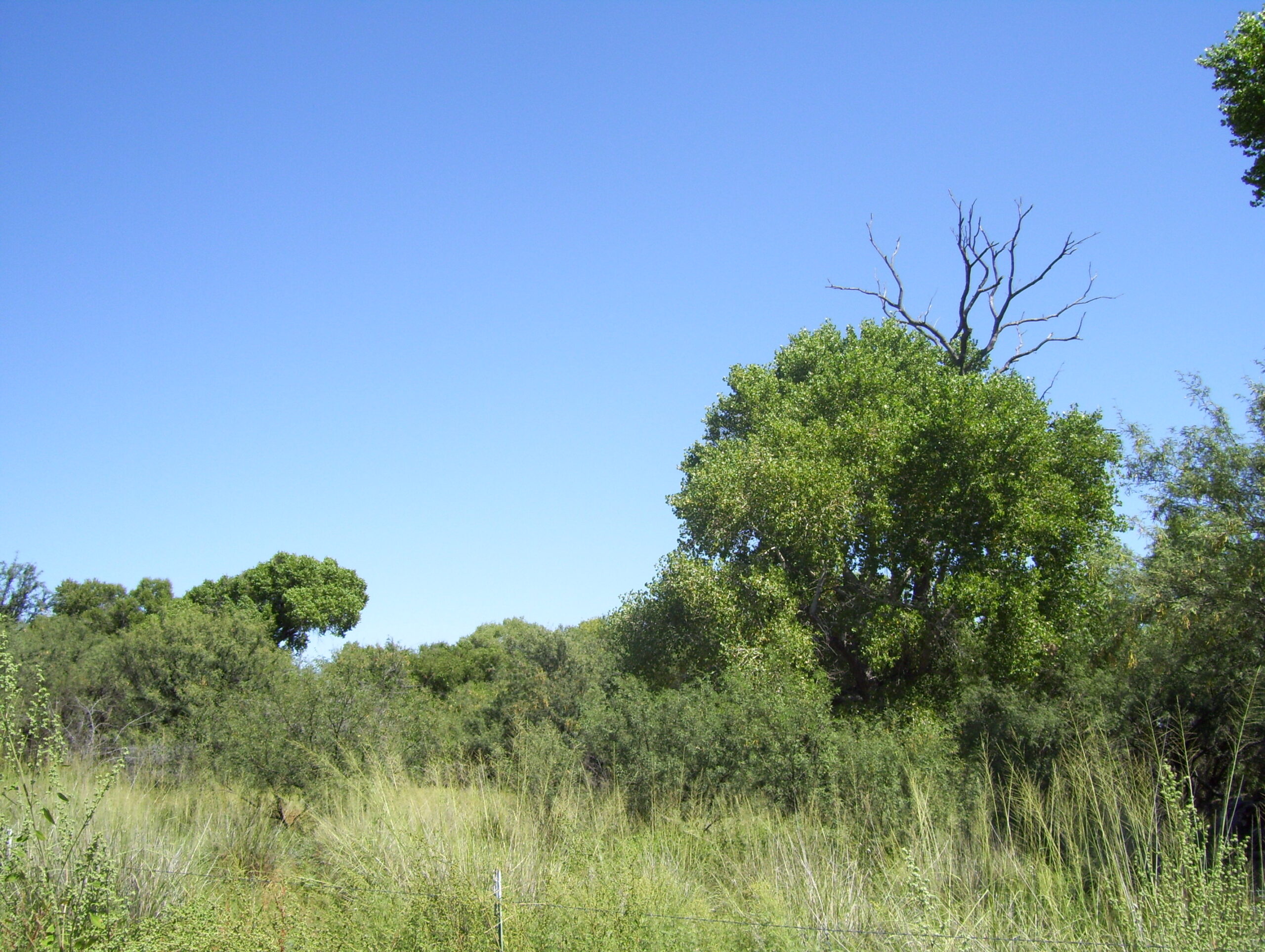
Fremont cottonwoods grow along streams, rivers, springs and seeps across the Southwest and into Mexico, reaching 12 to 35 meters tall with trunks up to 1.5 meters wide, according to the reference entry on Populus fremontii. Indigenous peoples used the wood for baskets, drums and carved figures, and the tree is now planted for riparian restoration and erosion control.
The U.S. Forest Service’s Fire Effects Information System notes that individual Fremont cottonwoods can live more than 130 years and that their streamside forests support golden eagles, Swainson’s hawks, red-tailed hawks and Bell’s vireos, which nest in the crowns. Along Arizona’s Verde River, more than half of the breeding bird species in pure cottonwood stands depended on that habitat alone, the Forest Service summary says.
Lochiel itself is a near-empty former border crossing in southern Santa Cruz County, sitting at about 4,685 feet in the southwestern San Rafael Valley, according to its Wikipedia entry. A few people still live there, near an abandoned customs station.
Other Old Trees, Other Outcomes
Fights over old trees have ended differently elsewhere. In Michigan, an 88-foot chinquapin oak in Sterling Heights was saved under a scaled-back building plan. In Philadelphia, a retired copyeditor stood beside a willow oak to stop a crew that had no removal permit.
In Lochiel, there was no permit fight and no redesign. After 71 days, the last of the four marked cottonwoods came down on the morning of Oct. 5, with at least 12 arrests counted by activists and no number given by CBP.
Get stories like this by email. Sign up for The Parent Diaries Letter.
This article was produced with AI assistance and edited for accuracy against the sources linked above.
Image: $1LENCE D00600D, CC BY-SA 3.0, via Wikimedia Commons